
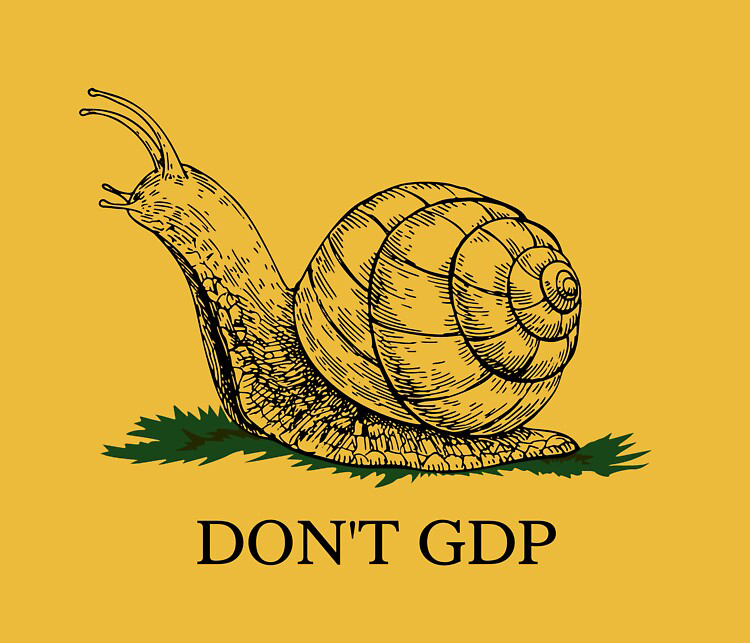
This is the first section in Part 2 of my recent grad school design paper in which I explore two contemporary, post-capitalist movements that have much to offer our creative endeavor to imagine a new, ecologically sensitive design story. Degrowth and solarpunk are neither finished experiments nor cautionary tales but living, still-unfolding proposals, argued over in real time by economists, novelists, and organizers who have not yet had the chance to get it wrong at scale. If taken together, they might really offer designers something the twentieth century’s non-capitalist laboratories could not: a vision of post-capitalism being authored collaboratively, in the open, before any state or market has had the opportunity to co-opt it for its own purposes.
Please find the preceding sections of the paper below if you’d like to catch up:
Part 1a: The Designed Object as Comrade in Constructivist Russia
Part 1b: Advertising as Cultural Strategy in Socialist Yugoslavia
Part 1c: Design in Cuba: Sufficiency and Resourcefulness in Action
Part 1d: The Design Institutes of China
…
What is Degrowth?
Degrowth is a term that sort of works against itself in that it sounds like a recession, a crash, or a forced push back to the stone-age. A recession, however, is in many ways the opposite of degrowth: an unplanned catastrophe inside a system that still demands growth and punishes its absence. Degrowth, by contrast, is what the ecological economist, Peter Victor, calls escaping that system “by design, not disaster.”56 The best definition I have found comes from the degrowth scholars Nick Fitzpatrick, Dennis Eversberg, and Matthias Schmelzer: “the downscaling of production and consumption to reduce ecological footprints, planned democratically in a way that is equitable while securing wellbeing.”57 The anthropologist, Jason Hickel, puts it almost identically: Degrowth is “a planned reduction of energy and resource use designed to bring the economy back into balance with the living world in a way that reduces inequality and improves human well-being.”57 Some recurring themes to pay attention to here: planned, democratic, equitable, well-being. Importantly, degrowth is not less of everything; it is less material throughput and more care, time, health, and ecological stability.
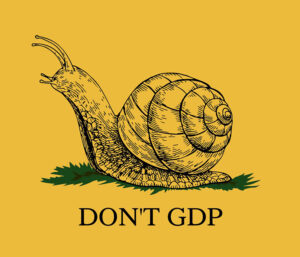 The degrowth movement in economics as we know it today caught fire in the 2000s.58 Today it is a genuinely crowded and pluralistic field filled with intellectual camps who argue plenty amongst themselves about “growth” and “development” and whether we can have planned, equitable downscaling inside an economy whose every institution is wired for expansion, but they all seem to agree on the headline: the wealthy nations must stop chasing endless growth, and they must do it on purpose, together, and fairly. One of the central claims of degrowth theorists is this: we cannot grow gross domestic product (GDP) forever on a finite planet without wrecking the planet, and the hoped-for escape hatch of decoupling economic output from emissions and material use (what some call “green growth”) is simply not happening at anything like the required scale.59 Growth, the degrowthers argue, is not a neutral fact of economic life but a hegemony, a world view so total that we mistake it for reality itself—precisely the “map for the territory” problem I described at the start of this paper. In their excellent book Enough is Enough: Degrowth, Capitalism, and Liberation Theology, Matthew Bernico and Dean Dettloff, note the connection between religion and economics and describe the hegemonic and idolatrous obsession with GDP as being: “More than an indicator or descriptor of economic trends, the GDP has become an active force in our world, shaping the world in its image, benefiting the wealthy, demanding attention, and disciplining those who dare to imagine another way of doing things.”60 The engine driving this malignant growth are economic imperatives like competition, accumulation, profit-making, and the unquenchable drive for ever more efficient productivity.
Degrowth theorist and philosopher, Kōhei Saitō, draws from Marx and emphasizes the distinction between use-value (the intrinsic capacity of a thing to meet a real human need, the way water quenches thirst) and exchange-value (a commodity’s price, which exists only in a market) arguing that capitalism systematically subordinates use-value to exchange-value by manufacturing scarcity out of abundance; a good example is freely flowing water being bottled, priced, and sold back to us.61 Ultimately, degrowth as an economic program suggests that we flip this priority around: how about an economy organized around use-value and human need rather than exchange-value and the whole ‘number-go-up’ game? This important critique offered by degrowth thinkers also carries a global awareness. What passes for ordinary “growth” in the rich world is, in the geographers Ulrich Brand and Markus Wissen’s phrase, an “imperial mode of living—a standard of consumption quietly subsidized by cheap labor, cheap resources, and absorbed pollution elsewhere.”62
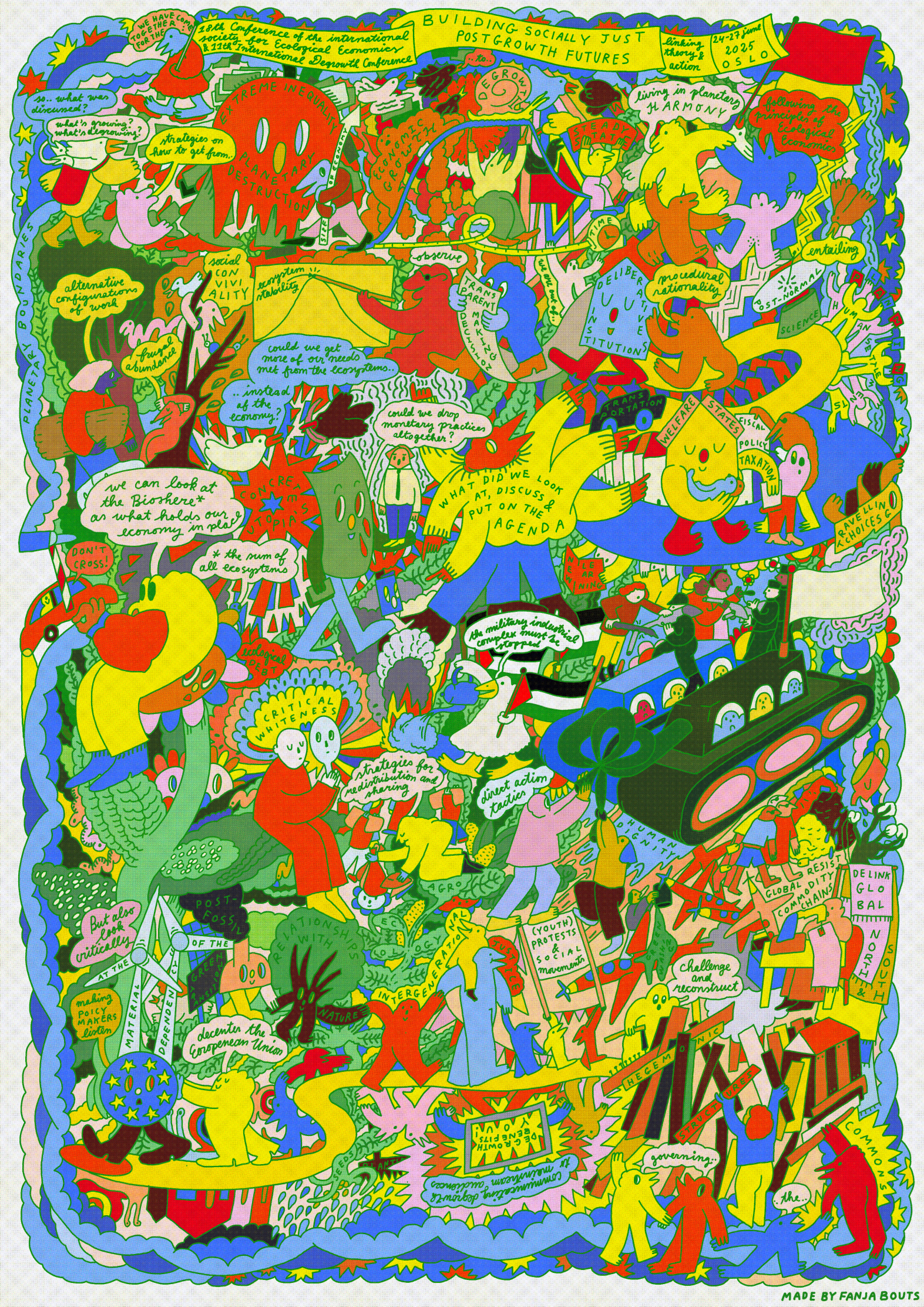 Poster credit: This poster “by artist Fanja Bouts gives an overview of the different topics that were addressed at the 18th Conference of the International Society for Ecological Economics and 11th International Degrowth Conference.”
So what does degrowth ask of a communication designer? First, the positive. degrowth seems to hand us a clear north star—use-value over exchange-value—and a set of practices that follow from it: design for sufficiency rather than excess; for durability, repairability, and long life rather than the engineered death of the twenty-four-month phone; and for real human need rather than manufactured desire. Degrowth would also like to rewrite the designer’s own working conditions. One of the movement’s most popular and concrete proposals is the radical reduction of working hours—and a designer freed from the treadmill of the rat race is a designer with the time to make fewer, better, more careful things.64 Degrowth’s insistence on democratic, participatory, commons-oriented planning likewise might reframe the designer as being less of a lone author and more as a facilitator of collective processes.65
Now the hard part. Degrowth forces designers to ask tough questions about whether some of what we currently do should exist at all and when the degrowth scholars I’ve read write up their lists of “socially undesirable sectors” to be deliberately and democratically wound down, planned obsolescence sits near the top—we should also keep in mind here that the movement itself was born, in the early 2000s, out of anti-advertising activism.66 The manufacture of desire, the differentiation of the indistinguishable is, according to degrowth, not a field to be greened but a sector to be substantially shrunk. This may be uncomfortable for some designers to read, and it is meant to be. But it is also, I think, strangely freeing. As Bernico and Dettloff point out, “it can be easy to find yourself constantly confronted with the anxiety of choice, of having to sift through a multitude of options for products, and to then realize you’re surrounded by cheap and unnecessary stuff. The stuff we do have is often unreliable, designed to break or slow down, or ‘disposable,’ which is really just a term to make us feel better about the convenience of polluting. Because capitalism needs to grow, there’s an economic incentive to encourage consumers to buy more and more things of worse and worse quality, pushed through advertising and gimmicks.”67 Importantly, as Bernico and Dettloff go on to remind us, we must be constantly aware of the intrinsic knowledge that having more stuff does not equal life improvement, and that reducing “consumption doesn’t mean reducing our quality of life but improving it, affirming—against a growth economy—that consumption is not the path to happiness.”67
…
Notes
56. Peter A. Victor, Managing Without Growth: Slower by Design, Not Disaster, 2nd ed. (Cheltenham: Edward Elgar, 2019); the phrase is quoted in Cédric Durand, Elena Hofferberth, and Matthias Schmelzer, “Planning beyond Growth: The Case for Economic Democracy within Ecological Limits,” Journal of Cleaner Production 437 (2024): 140351, at 1.
57. Nick Fitzpatrick, Dennis Eversberg, and Matthias Schmelzer, “Exploring the Degrowth Movement: A Survey of Conceptualisations, Strategies, and Tactics,” Energy Research & Social Science 124 (2025): 104045, at 1 (quoting Timothée Parrique); and Jason Hickel, “What Does Degrowth Mean? A Few Points of Clarification,” Globalizations 18, no. 7 (2021): 1105, quoted in Durand, Hofferberth, and Schmelzer, “Planning beyond Growth,” 1. See also Hickel, Less Is More: How Degrowth Will Save the World (London: William Heinemann, 2020).
58. Durand, Hofferberth, and Schmelzer, “Planning beyond Growth,” 2.
59. Fitzpatrick, Eversberg, and Schmelzer, “Exploring the Degrowth Movement,” 1–2; see especially Jefim Vogel and Jason Hickel, “Is Green Growth Happening? An Empirical Analysis of Achieved versus Paris-Compliant CO₂–GDP Decoupling in High-Income Countries,” Lancet Planetary Health 7, no. 9 (2023): e759–e769.
60. Bernico and Dettloff, Enough is Enough: Degrowth, Capitalism, and Liberation Theology, 24.
61. Kōhei Saitō, Slow Down: The Degrowth Manifesto, trans. Brian Bergstrom (New York: Astra House, 2024); see also my own discussion of use-value and exchange-value in Jesse Turri, “Sustainable Design and Telling a New Story” (paper, CODS-506, Kutztown University, September 22, 2024), 3–5.
62. Ulrich Brand and Markus Wissen, The Imperial Mode of Living: Everyday Life and the Ecological Crisis of Capitalism (London: Verso, 2021), 26–26.
63. Paul Micklethwaite, “Design Against Consumerism,” in A Companion to Contemporary Design Since 1945 (Hoboken, NJ: Wiley-Blackwell, 2019), 436–56; the Ulm School lineage is traced in Turri, “Sustainable Design and Telling a New Story,” 6–9.
64. Fitzpatrick, Eversberg, and Schmelzer, “Exploring the Degrowth Movement,” 2, noting work-time reduction as “the second-most popular proposal in degrowth literature”; see also Nick Fitzpatrick, Timothée Parrique, and Inês Cosme, “Exploring Degrowth Policy Proposals: A Systematic Mapping with Thematic Synthesis,” Journal of Cleaner Production 365 (2022): 132764.
65. Durand, Hofferberth, and Schmelzer, “Planning beyond Growth,” esp. 4–6.
66. On planned obsolescence among the “socially undesirable sectors” to be dismantled, see Durand, Hofferberth, and Schmelzer, “Planning beyond Growth,” 4, and Schmelzer, Vetter, and Vansintjan, The Future Is Degrowth, 215–28; on degrowth’s origins in anti-advertising activism, see Fitzpatrick, Eversberg, and Schmelzer, “Exploring the Degrowth Movement,” 1–2.
67. Bernico and Dettloff, Enough is Enough: Degrowth, Capitalism, and Liberation Theology, 4–5.


Pingback:Designing for Beauty, Sufficiency, and Collective Care Part 3a: Imagining the World of The Post-Capitalist Designer – What has changed?
Pingback:Designing for Beauty, Sufficiency, and Collective Care Part 3b: Imagining the World of The Post-Capitalist Designer – Identifying Post-Capitalist Design Needs
Pingback:Designing for Beauty, Sufficiency, and Collective Care Part 3c & Conclusion