
This is the third section in Part 1 of my recent grad school design paper in which I explore four laboratories of non-capitalist and postsocialist design. Please find the preceding sections below if you’d like to catch up:
Part 1a: The Designed Object as Comrade in Constructivist Russia
Part 1b: Advertising as Cultural Strategy in Socialist Yugoslavia
…
Cuba might be the most radical of our four laboratories, and, since it is one of only two still running, could be quite useful. After the revolution things consolidated and private enterprise was finally eliminated around 1968, commercial advertising simply vanished from Cuban public space; the billboard hawking soap or rum was replaced by what the scholar, Paloma Duong, calls the “monumental political advert,” which was often a giant oversized billboard with the words of Fidel or Raúl rather than a corporate logo.35 Here, then, is the purest test we can put communication design to: what does it become when the commercial market is removed almost entirely—and what happens to it, decades on, when the state economy that replaced the market begins to fail? I should say up front, with Duong, that we are not looking at “the absence of capitalism but the presence of a differently organized kind of capital”; the single-party Cuban state remains, in her phrase, “the main capitalist actor.”36
In the 1960s and ’70s, Cuban designers like Félix Beltrán, René Mederos, and Alfredo Rostgaard, working for the solidarity organizations OSPAAAL and OCLAE and their magazine Tricontinental (see fig. 5), produced what is now widely regarded as some of the most accomplished graphic design of the twentieth century. The design historian Catherine Moriarty puts her finger on precisely why it could be so good: “With no commercial client to satisfy but instead a revolutionary agenda… a wide variety of means were commandeered and freely experimented with.”37 The work was not selling anything but was rallying support for the decolonizing world, grounded in what Jean-Paul Sartre, writing in Tricontinental, called the “ethical dimension that propaganda must disclose if it is to mean anything at all.”39
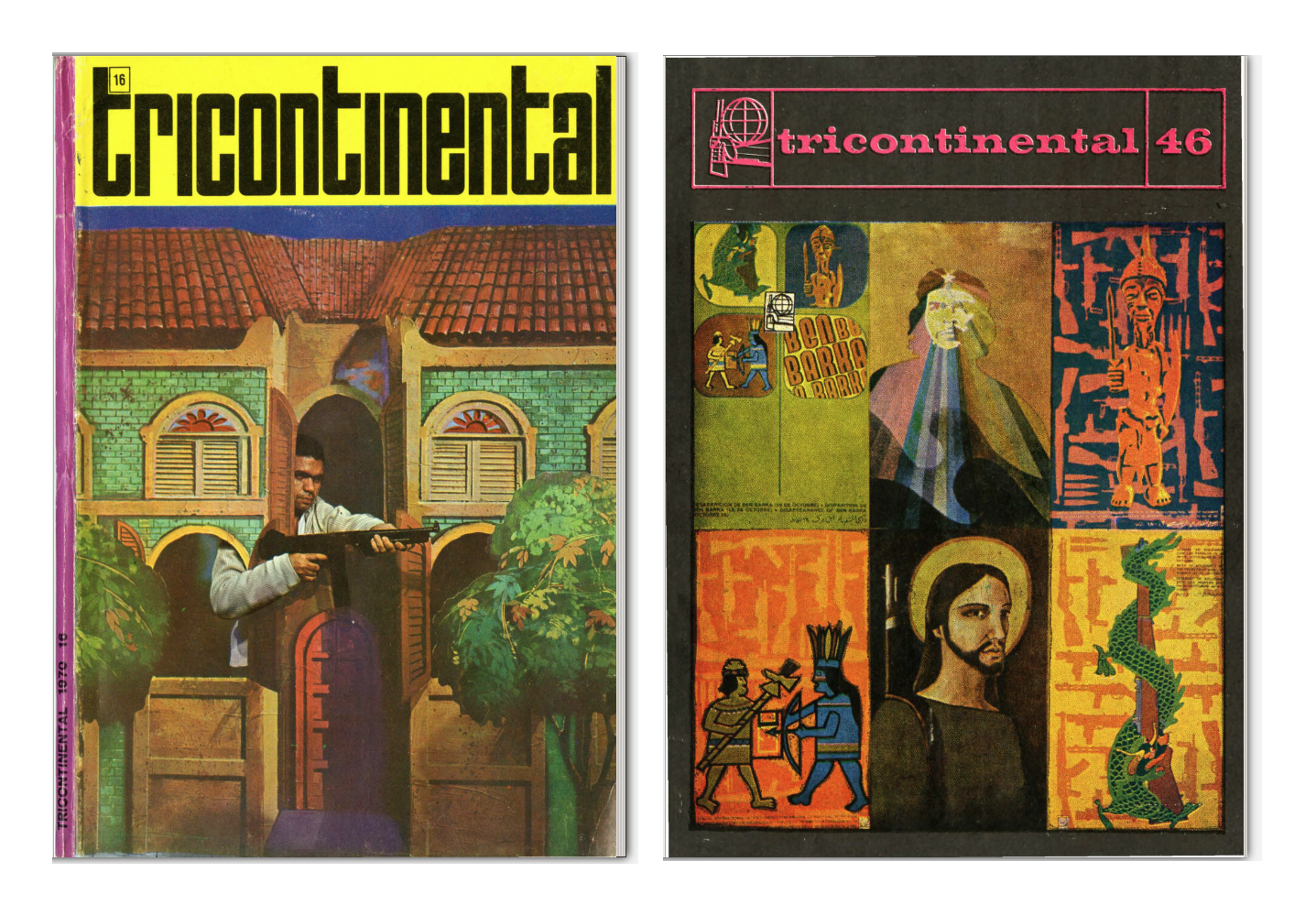
Figure 5. “Tricontinental Magazine was published by the Organization in Solidarity with the People of Africa, Asia, and Latin America (OSPAAAL). It began publishing in 1966 in several languages, including English, Spanish and French, and circulated in more than 80 different countries. It included images and photographs. With editorial offices in Havana, Cuba, it was distributed from Paris and France.”37
However, as Lucila Fernández Uriarte recounts, Cuba built its formal design institutions (the school ISDI in 1984, the national design office ONDI in 1981) on the rigorously rationalist model of the German Ulm School, and did so exactly as the West was abandoning it which produced a “uniquely defensive” modernism in which the messy diversity of real human needs collapsed into “one problem, one solution, repeating the homogenizing mistakes of the old Modern Movement.”40 Fernández Uriarte even observes that this was not the first time “design and revolution were interrelated; the time of Soviet Constructivism which, although it started well, had a tragic end known to all.”40
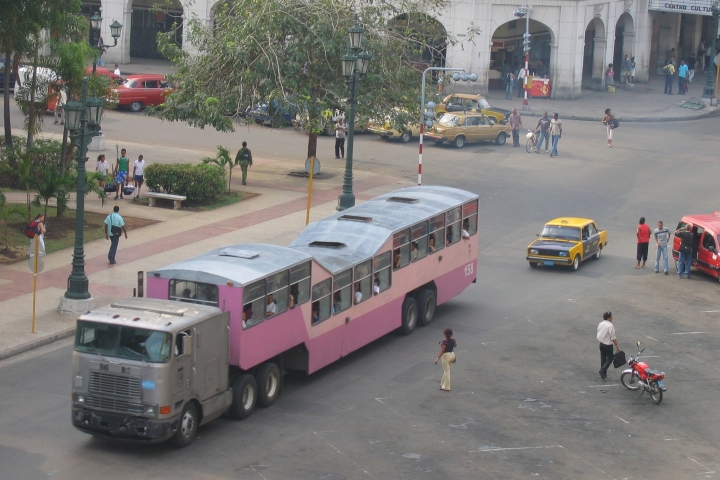
Then came the test. When the Soviet Union collapsed and its subsidies dried up, Cuba fell into the “Special Period” in 1990, an official economy of survival in which the state-directed design system more or less stopped functioning.41 Interestingly, into that vacuum rushed the artist collective Ordo Amoris, who began documenting ordinary Cubans’ inventos, which are objects of pure improvisation, made with “no preceding plan or design,” born of “a sharp sense of the temporary character of life”; some examples include things like a walking stick fitted with a bicycle bell so that seniors could be heard in the bike-choked streets, or the “camel” mega-buses which were welded together to keep Havana moving.42 This is a wonderful example of sufficiency-design and anti-consumerist resourcefulness that, as Fernández Uriarte notes, points “not [to] the banal in an opulent society, but rather [to] the absolute failings of consumerism.”43
We should be careful, however, not to romanticize Cuba. Duong is relentless on this point indicating that across these decades the market “did arrive, only under a different guise,” and what fills the gaps is not a socialist utopia but quite a bit of surveillance, exploitation, and an entirely unextinguished desire for the very global market the state claims to have transcended.44 So Cuba braids together every lesson of this section at once. It shows that design freed from the commercial market can be genuinely beautiful and oriented toward collective care, and that a dignified sufficiency can flower from sheer constraint (the inventos), but also that a single state-client can still flatten and homogenize. Abolishing the market by decree risks driving capitalism underground only to change its clothes.
…
Notes:
35. Paloma Duong, Portable Postsocialisms: New Cuban Mediascapes After the End of History (Austin: University of Texas Press, 2024), 18, 25. On the elimination of private enterprise and commercial advertising from public space around 1968 and its replacement by “monumental political adverts,” see 18 and 25.
36. Duong, Portable Postsocialisms, 16, 9. The phrase “the main capitalist actor” appears at 9; the formulation of postsocialism as “not the absence of capitalism but the presence of a differently organized kind of capital” at 16.
37. Catherine Moriarty, “Designs for Solidarity: Photography and the Cuban Political Poster 1965–1975,” Photoworks (Autumn 2008/Winter 2009): 60–65. Moriarty’s discussion of the freedom afforded by the absence of a commercial client, and of the Cuban appropriation of Pop art and Warhol’s silkscreen seriality, anchors the account of the OSPAAAL, OCLAE, and Tricontinental posters.
38. Tricontinental, 1970 (1970), magazine cover, Radical Ephemera and Underground Publications, The San Diego State University Library, Special Collections and University Archives, accessed June 24, 2026, https://digitalcollections.sdsu.edu/do/c1385aab-45df-428f-958e-5977f62278d6.
39. Jean-Paul Sartre, Tricontinental (November/December 1967), quoted as the epigraph in Moriarty, “Designs for Solidarity.”
40. Lucila Fernández Uriarte, “Modernity and Postmodernity from Cuba,” Journal of Design History 18, no. 3 (2005): 247. On the founding of EDI (1969), ONDI (1981), and ISDI (1984), the adoption of the Ulm model as a “uniquely defensive” modernism reducing design to “one problem, one solution,” and the explicit comparison to the “tragic end” of Soviet Constructivism, see 247.
41. Fernández Uriarte, “Modernity and Postmodernity from Cuba,” 248.
42. Fernández Uriarte, “Modernity and Postmodernity from Cuba,” 248–49. On the Ordo Amoris group’s documentation of inventos—including the walking stick with a bicycle bell (fig. 2) and the “camel” buses—and the description of improvisation as proceeding with “no preceding plan or design,” see 248–49.
43. Fernández Uriarte, “Modernity and Postmodernity from Cuba,” 250.
44. Duong, Portable Postsocialisms, 23, 29. “The market did arrive, only under a different guise” appears at 23; Duong’s caution against “the essentialist romanticizing of disconnected authenticity” at 29.


Pingback:Designing for Beauty, Sufficiency, and Collective Care – Part 2a: What is Degrowth?
Pingback:Designing for Beauty, Sufficiency, and Collective Care Part 3a: Imagining the World of The Post-Capitalist Designer – What has changed?
Pingback:Designing for Beauty, Sufficiency, and Collective Care Part 3b: Imagining the World of The Post-Capitalist Designer – Identifying Post-Capitalist Design Needs