
This is Part 3 of my recent grad school design paper in which I attempt to imagine a not-so-distant future world for the post-capitalist designer. We begin by de-commodifying the basic necessities of life (Part 3a) before proceeding to identify some post-capitalist design needs (Part 3b) which will then allow us to consider the roles of the Regenerative Commons Designer (Part 3c).
Please find the preceding sections of the paper below if you’d like to catch up:
Part 1a: The Designed Object as Comrade in Constructivist Russia
Part 1b: Advertising as Cultural Strategy in Socialist Yugoslavia
Part 1c: Design in Cuba: Sufficiency and Resourcefulness in Action
Part 1d: The Design Institutes of China
Part 3a: Imagining the World of The Post-Capitalist Designer – What has changed?
…
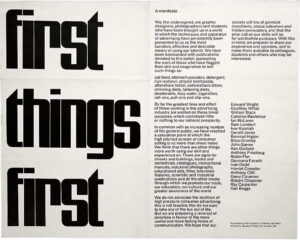 “In common with an increasing number of the general public, we have reached a saturation point at which the high pitched scream of consumer selling is no more than sheer noise. We think that there are other things more worth using our skill and experience on. There are signs for streets and buildings, books and periodicals, catalogues, instructional manuals, industrial photography, educational aids, films, television features, scientific and industrial publications and all the other media through which we promote our trade, our education, our culture and our greater awareness of the world.” –First Things First Manifesto, 196497
With the basic needs in life de-commodified, we may now ask: what is a designer for in such a world? We should also be honest and admit what we’ve already learned, that an enormous amount of communication design exists to move commodities, that is: to manufacture desire, to differentiate the indistinguishable, and to dress planned obsolescence up in trendy seasonal colors. So perhaps the most difficult part for some to accept is that in a post-capitalist economy a great deal of what currently fills a designer’s day may simply evaporate.98 This may sound like an extinction event for the profession but it’s not. As Matthew Wizinsky (the same designer we met teaching solarpunk a few pages ago) argues in his book Design After Capitalism, the task is to reorient design away from producing commodities for exchange and toward producing more equitable conditions, relationships, and ways of living.99
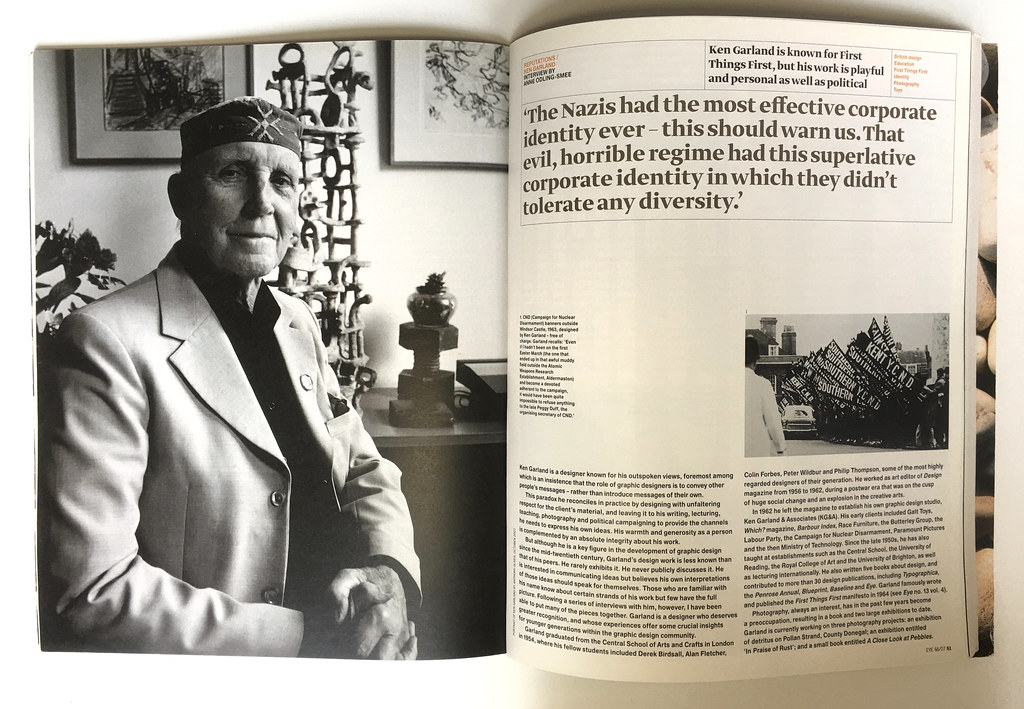
Magazine spread above: Winter 2007 edition of Eye Magazine, featuring an interview with Ken Garland that explores his life and career.
Along with British graphic designer, Ken Garland (one of the original 22 signatories of the First Things First Manifesto quoted above), we can imagine there would be need of practical wayfinding and legibility materials to be designed for shared resources like perhaps a tool library, a community fridge or a repair café. Open documentation would be vital in a situation like this so a community can run and reproduce its own systems rather than depend on a vendor—Alix Gerber describes how the mutual-aid networks she studied designed “things all the time, like a spreadsheet to match neighbors’ needs with other neighbors who can help. They also design roles and processes in the organization, Instagram posts, and even a wooden enclosure to keep a community fridge insulated from the cold. These things address the practical problems the network encounters in its daily operations.”100 Gerber also points out the continued need for the design of maps and various assembly tools that allow for the visualization and facilitation of genuinely democratic processes in which people will ultimately decide things together.101
One important thing to note here is that almost none of these needs is about deceptive seduction or enticement, and few of them sit comfortably under the old job title of “graphic designer.” The post-capitalist designer is needed less as a manufacturer of desire and more as a kind of connective tissue for a commons—someone who helps a community see itself in new ways, steward its resources, and remember how to make, how to mend, and how to inspire. That is a broader, stranger, and frankly more interesting vocation than the one most of us trained for, and it refuses to collapse into a single role. To sketch it out, the section that follows imagines what I am calling the Regenerative Commons Designer, through three overlapping hats: the moral compass, the community facilitator, and the speculative artist.
…
Notes
97. “First Things First Manifesto,” 1964, http://www.designishistory.com/1960/first-things-first/, Accessed July 13, 2026.
98. On advertising and planned obsolescence among the “socially undesirable sectors” to be deliberately wound down, see note 66 above.
99. Matthew Wizinsky, Design After Capitalism: Transforming Design Today for an Equitable Tomorrow (Cambridge, MA: MIT Press, 2022). This is the same Matthew Wizinsky quoted in Heath, “Solarpunk Started Out as a Speculative Fiction”; see note 81 above.
100. On the mutual-aid spreadsheet and the insulated community fridge as everyday designed objects embedded with a transformative vision, see Gerber, “Building a New World in the Shell of the Old,” 5 (see note 85 above)
101. On co-created maps and participatory assembly tools as design for democratic deliberation, see Gerber, “Building a New World in the Shell of the Old,” 10–13.

Pingback:Designing for Beauty, Sufficiency, and Collective Care Part 3c & Conclusion