
This is the fourth section in Part 1 of my recent grad school design paper in which I explore four laboratories of non-capitalist and postsocialist design. Please find the preceding sections below if you’d like to catch up:
Part 1a: The Designed Object as Comrade in Constructivist Russia
Part 1b: Advertising as Cultural Strategy in Socialist Yugoslavia
Part 1c: Design in Cuba: Sufficiency and Resourcefulness in Action
…,
China is the fourth laboratory we will visit, and like Cuba it has the advantage of still being online today. But where Cuba shows us what happens when the market is yanked out almost overnight, China offers us a sprawling institutional experiment that has run continuously from the early 1950s to the present, one that survived Maoism, the Cultural Revolution, and the rush back toward the market after 1979 which produced a type of organization with almost no equivalent in the West.45 The architectural historians, Charlie Q. L. Xue and Guanghui Ding, call it simply the design institute, and their book carries the wonderfully telling subtitle From Mao to Market.45
First, a little background. After the Chinese Communists took power in 1949, the private design firms (small organizations of at most a few dozen people) that had flourished in port cities like Shanghai since the 1920s were gradually phased out and folded into enormous state-owned institutes; the East China Architectural Design company, founded in Shanghai in 1952, opened with two hundred staff and within two years had grown past a thousand.46 These were not “firms” a Western designer would recognize. The institute uneasily housed mature design masters working shoulder to shoulder with armies of salaried technicians which historian, Henry-Russell Hitchcock, referred to as the “architecture of bureaucracy” and the “architecture of genius” being under one roof.47 Interestingly, the institute was called a danwei, or a “work unit,” and it was run less like a business and more like an autonomous little society.48 It operated its own canteens and dormitories, kindergartens and clinics, free schooling for employees’ children and medical care for their families—what the Chinese of the period called, without irony, a “socialist big family.”48 In other words, design was embedded inside a structure of collective care. The designer’s housing, healthcare, and children’s education were not prizes to be won on a market but came with the work.
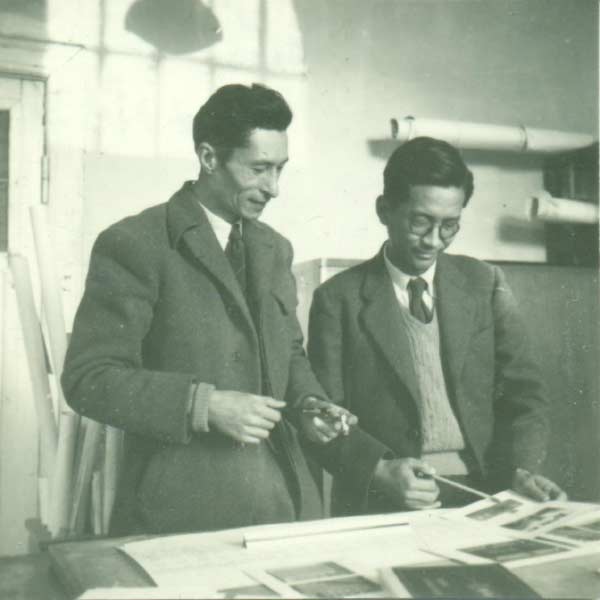
Here we might stop and ask an obvious question: what did this do to the actual design? For graphic and communication design, specifically, the outlook wasn’t great. With private enterprise abolished, commercial graphic design was denounced as a symbol of “Western lifestyle” and a “waste of national resources,” and design on the mainland was subordinated almost entirely to Party propaganda; the Cultural Revolution (1966–1976) brought about the near-total elimination of commercial graphic design altogether.49 Then in 1957, Xue and Ding describe how the British-trained urban planner, Chen Zhanxiang, “published a dazibao (a handwritten, wall-mounted poster using large-sized Chinese characters) during the Hundred Flowers Campaign, claiming that the bureaucratic system of state-owned design institutes reduced architectural design to noncreative, manual work.”50 The deputy minister at the time, Zhou Rongxin, responded by emphasizing that the state-owned institutes, with their multidisciplinary staff and close collaboration, were fit for socialist construction and Chen was branded as a “rightist” and shipped to a labor camp.50 Sadly, individual creativity throughout the Mao years was routinely condemned as a “bourgeois tendency.”51 Once the market returned after 1979, the institutes simply “surfed the economic wave,” merging into giant state-controlled conglomerates and competing, today, for the very same star-designer spectacle as any global firm.52
In 2012, however, the story takes a welcome ecological turn when the Chinese Communist Party writes the goal of building an “ecological civilization” (shengtai wenming) into its own constitution, and in 2018 into the national one, which was essentially an explicit, state-level attempt to trade the story of endless industrial growth for one of living within ecological limits.53 As Mary Evelyn Tucker and John Grim, directors of the Yale Forum on Religion and Ecology, have argued, the phrase is more than a slogan: it gathers up China’s deep Confucian, Daoist, and Buddhist traditions of human and nature reciprocity and offers them, alongside Western process-relational philosophy, as the seed of an alternative to the consumerist civilization the whole planet has inherited.54 Encouragingly, according to Xue and Ding, it seems that today the very design institutes that surfed the economic wave are now the appointed instruments of the ecological turn, building the green-architecture research arms, eco-city plans, and energy codes through which the policy is put into action.55
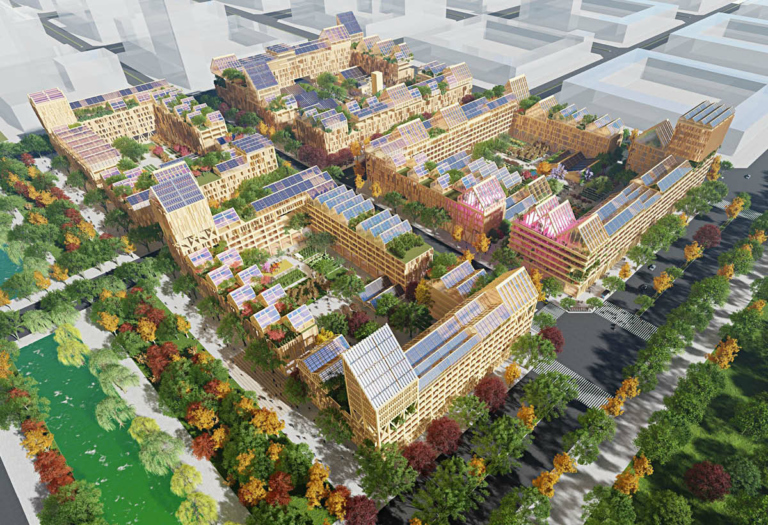 Image credit: “A totally self-sustainable neighborhood with an energetic and agricultural point of view, designed by Guallart Architects for the new eco-city of Binhai, Tianjin.”
So we can say with confidence that the living socialist laboratory of China teaches us a couple of important lessons here. On the cautionary side, a collective that flattens individual voice into bureaucratic routine, that mistakes uniformity for solidarity and sends its dissenters to labor camps, does not liberate design any more than the market does. But China hands us another item to place next to the hammer of Yugoslavia and the comrade-object of Russia: the institution itself. China’s work units housed inside the design institutes (the danwei) can be viewed positively as a concrete expression of the post-capitalist designer that we will try to imagine later in this paper: a designer who has guaranteed housing, healthcare, and livelihood, and who is freed from the grinding precarity of chasing clients and making useless stuff.
…
Notes:
45. Charlie Q. L. Xue and Guanghui Ding, A History of Design Institutes in China: From Mao to Market (London and New York: Routledge, 2018).
46. Xue and Ding, A History of Design Institutes in China, 22–24. On the phasing out of private firms after 1949 and the founding of the East China Architectural Design company on May 19, 1952—its staff growing from more than 200 to 1,044 by the end of 1953—see 22–23.
47. On Hitchcock’s categories, see Xue and Ding, A History of Design Institutes in China, 1; the original formulation appears in Henry-Russell Hitchcock, “The Architecture of Bureaucracy and the Architecture of Genius,” Architectural Review 101 (January 1947): 4–6.
48. Xue and Ding, A History of Design Institutes in China, 3, 25, 45. On the danwei (work unit) and its welfare functions more broadly, see also David Bray, Social Space and Governance in Urban China: The Danwei System from Origins to Reform (Stanford: Stanford University Press, 2005).
49. Wendy Siuyi Wong, “Detachment and Unification: A Chinese Graphic Design History in Greater China Since 1979,” Design Issues 17, no. 4 (Autumn 2001): 52–53. The characterization of commercial graphic design as a symbol of “Western lifestyle” and a “waste of national resources” is Wong’s paraphrase of Shou Zhi Wang, “Chinese Modern Design: A Retrospective,” in Design History: An Anthology, ed. Dennis P. Doordan (Cambridge, MA: MIT Press, 1995), 230.
50. Chen Zhanxiang’s 1957 dazibao, “Architect or a Tracing Machine,” and Zhou Rongxin’s rebuttal are recounted in Xue and Ding, A History of Design Institutes in China, 19. Chen was labeled a “rightist” and sent to a labor camp for thought-reform.
51. Xue and Ding, A History of Design Institutes in China, 28.
52. Xue and Ding, A History of Design Institutes in China, esp. 85–112; “Surfing the Economic Wave” is the title of the book’s second part (57). On the restructuring of large institutes into state-controlled conglomerates and “celebrity architect” studios, see 85–88.
53. On “ecological civilization” (shengtai wenming)—its emergence under Hu Jintao at the 17th Party Congress (2007), its incorporation into the Chinese Communist Party constitution in 2012, and its addition to the national constitution in March 2018—see Sam Geall and Adrian Ely, “Narratives and Pathways towards an Ecological Civilisation in Contemporary China,” The China Quarterly 236 (December 2018): 1175–1196.
54. Yale Forum on Religion and Ecology, “Ecological Civilization,” accessed June 2026, https://fore.yale.edu/Ecological-Civilization. The Forum is directed by Mary Evelyn Tucker and John Grim of Yale University.
55. On China’s state-owned design institutes as the principal agents of green architecture and eco-city policy—including the national Green Architecture Assessment Standard and the Shenzhen Institute of Building Research—see Xue and Ding, A History of Design Institutes in China, 113, 131–135.


Pingback:Designing for Beauty, Sufficiency, and Collective Care Part 3a: Imagining the World of The Post-Capitalist Designer – What has changed?
Pingback:Designing for Beauty, Sufficiency, and Collective Care Part 3b: Imagining the World of The Post-Capitalist Designer – Identifying Post-Capitalist Design Needs
Pingback:Designing for Beauty, Sufficiency, and Collective Care Part 3c & Conclusion