
This is Part 1a of my recent grad school design paper, the introduction can be read here.
…
“Rodchenko names a new kind of emotionally affective object: the comradely object of socialist modernity. Unlike the commodities he encounters on his visit to capitalist Paris, which elicit a possessive relation that makes the objects into “slaves,” things made in the socialist East will actively promote egalitarian socialist culture. They will replace the pleasure of commodity possession, not with its presumed Communist opposite of material renunciation, but with something far more peculiar and psychologically powerful: the material object as an active, almost animate participant in social life.” –Christina Kiaer10
In October 1917 The Bolsheviks, led by Vladimir Lenin, seized power in Russia which set in motion not just a change of government but an attempt to remake the entire fabric of everyday life, and by the time the civil war gave way to the early 1920s, the Bolsheviks had—at least in their official program and in the imagination of their cultural vanguard—abolished private property, private trade, and the market as the organizing engine of social life.11 As Christina Kiaer details in her wonderful book, Imagine No Possessions: the Socialist Objects of Russian Constructivism, the generation of avant-garde artists who threw themselves behind the Revolution did not see a catastrophe but an opening. The market for which art and design had previously been made—the bourgeois market of private patrons and luxury goods—was supposed to be passing away, and with it the entire purpose for which objects had been produced up until then.12 And so these Russian artists faced a daunting and wonderful question: if we are no longer making things to be bought, sold, and hoarded, then what on earth are we making things for?
The Constructivists, however, were not naive about the semi-capitalist period in which they lived (the period in Soviet history known as the New Economic Policy or NEP) and they were also aware that the Russian economy was still largely agricultural and primitive compared to the industrialized West, but their solution, which Kiaer describes as one “anticipating a future socialist culture that had not yet arrived,” addressed the deepest problem in Marx’s whole analysis of capitalism: the problem of commodity fetishism.13 This is a big chunk of Kiaer’s book and seems worth slowing down for. In the famous fourth section of the first chapter of Capital, Marx argues that the commodity is a kind of liar and presents itself to us as a thing that appears from nowhere (poof!) with an inherent, magical value—a price that seems to belong to the object itself—while concealing the actual process of social relations and human labor that produced it.14 The commodity is a fetish: a fixation on an object that stands between people, organizing our desires and our relationships, all while hiding the exploitation and alienation concealed inside it. The result, in Marx’s own words, is a world in which “the definite social relation between men [sic] themselves … assumes here, for them, the fantastic form of a relation between things.”15 In other words: our possessions do not serve us, we end up serving our possessions.
However, rather than concluding that the solution is simply to have fewer things, or to retreat into a grim asceticism, the most ambitious of the Constructivist theorists—Boris Arvatov, in his extraordinary 1925 essay “Everyday Life and the Culture of the Thing”—proposed something far more interesting. The problem, Arvatov argued, was not the object itself but the kind of relationship capitalism forces us into with the object.16 Under a capitalist system, as Kiaer explains, things are simply “dead”: they are passive, inert, fetishized possessions that exist only to be owned and displayed and what happens, ultimately, is that these things end up dominating their owner’s lives through consumerism.17 But under socialism, Arvatov imagined, the thing could be reborn as something alive—an active co-worker (his term, which Kiaer renders beautifully), a participant in the building of everyday life rather than a trophy of private accumulation.18 The socialist object would not stand between people concealing their labor; it would stand alongside them, transparent and collaborative. It would be, in Rodchenko’s own phrase, our comrade.
This is the part of the story that I find to be beautiful. The phrase ‘object as comrade’ comes directly from a series of letters Rodchenko wrote to his partner, and fellow designer, Varvara Stepanova in 1925, from Paris where he had gone to install the Soviet section at the great Exposition Internationale des Arts Décoratifs.19 Kiaer seems to treat these letters as the emotional and theoretical core of the whole Constructivist project. Rodchenko is apparently so repulsed by bourgeois Paris and its glittering boutiques and luxury commodities that he accurately describes the explicit and shameful Western objectification of women he encounters in Western media and advertising while also characterizing the objects he sees around him as “kept women,” things whose only purpose is seduction and display; yet he is also, strangely, attracted, feeling the pull of the beautiful commodity even as he despises what it represents.20 Out of this contradiction, he forms the alternative he longs for: a world in which, as he writes, “our things in our hands must be equals, comrades.”21 Not mistresses to be possessed. Not masters to be served. Comrades. Friends. Equals. Co-workers in a shared life.
This notion of an object being our comrade sounds, at first, like a cute slogan for an overpriced “ethical” tote bag (or maybe to some it sounds like complete nonsense) and that is precisely because we are so thoroughly marinated in the logic of the commodity. But Rodchenko and Arvatov meant it with total seriousness, and it carried concrete consequences for how they believed things should actually be designed. In one of his letters Rodchenko writes, “Things take on meaning, become friends and comrades of the person, and the person learns how to laugh and be happy and converse with things.”21 Above all, the comrade-object had to be honest about its own construction. Where the commodity hides the labor and the social relations that made it, the socialist object would lay them bare; the Constructivist thing, in Kiaer’s words, was meant to be “transparent in its construction and use, openly declaring itself a product of collective labor rather than concealing its origins behind a veneer of luxury.”22 No hidden seams, no decorative mystification, no lies about how it was made; A thing that shows you how it works is a thing that refuses to conceal its own labor. These objects were also to be flexible and multifunctional: Rodchenko’s folding and convertible furniture, and the celebrated Workers’ Club interior he designed for that very Paris exhibition, adapted to the changing, communal needs of their users rather than asserting a fixed, ownable, status-bearing identity.23 Best of all, they were to be participants—active collaborators in the construction of a new collective everyday life, what the Constructivists called byt.24
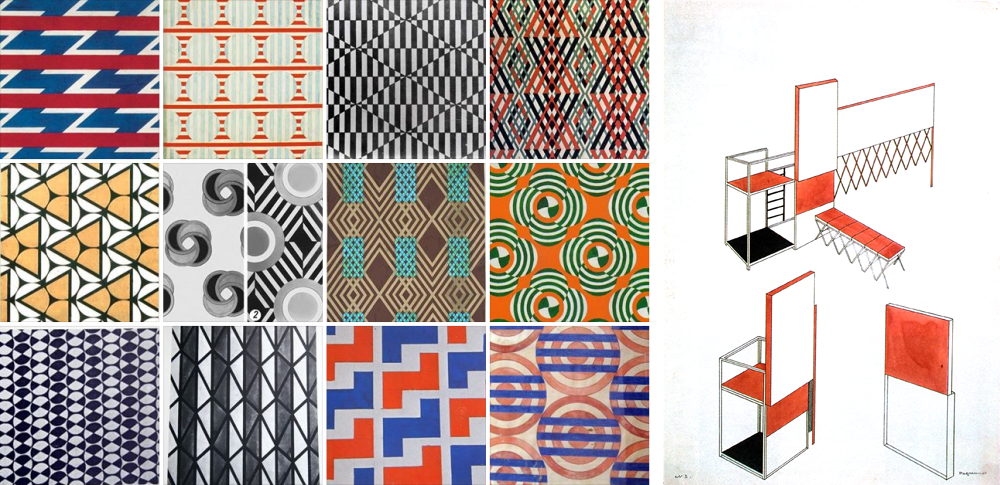
Figure 1 (left): Textile designs by Varvara Stepanova; Figure 2 (right) Rodchenko’s folding and convertible furniture designs for the Worker’s Club interior.
Interestingly, creating textile and fashion designs while working at the First State Cotton-Printing factory, Liubov’ Popova and her colleague Varvara Stepanova were “the only Constructivists to see their designs for everyday utilitarian things actually mass-produced and distributed in the Soviet economy.”25 Sadly, the young Soviet economy simply lacked the industrial capacity to mass-produce much else, let alone Rodchenko’s elegant, transparent furniture designs, and the experimentation of the 1920s was soon crushed by the forced industrialization and cultural clampdown of the Stalin era, in which Constructivism was denounced as bourgeois “formalism” and design was subordinated to the planned economy and the kitsch monumentalism of Socialist Realism.26 The comrade-object curdled, in the end, into the shoddy, scarce, demoralizing goods of late Soviet life—objects that were neither comrades nor commodities but simply huge disappointments. This is the first and most important lesson of our first laboratory: abolishing the market is not the same as liberating design. What made Rodchenko’s and Stepanova’s vision beautiful was not merely that it was anti-capitalist but that it was honest, collaborative, and democratic—and a state that suppressed the market only to install itself as a single, unaccountable client produced not the comrade-object but the propaganda poster. The future we are chasing must learn from the beauty of the Constructivist dream while refusing the authoritarian trap that destroyed it.
…
Notes
- Christina Kiaer, Imagine No Possessions: The Socialist Objects of Russian Constructivism (Cambridge, MA: MIT Press, 2005), Introduction
- Sheila Fitzpatrick, The Russian Revolution, 4th ed. (Oxford: Oxford University Press, 2017), 93–98. On the Bolshevik aspiration to transform everyday life (byt) and the broader cultural-revolutionary program of the early 1920s, see also 169–73.
- Christina Kiaer, Imagine No Possessions: The Socialist Objects of Russian Constructivism, 4
- Christina Kiaer, Imagine No Possessions: The Socialist Objects of Russian Constructivism, chap. 1
- Karl Marx, Capital: A Critique of Political Economy, vol. 1, trans. Ben Fowkes (London: Penguin Books, 1990), 165; the analysis of “The Fetishism of the Commodity and Its Secret” appears at 163–77. For Kiaer’s framing of Constructivism as an explicit response to commodity fetishism, see Christina Kiaer, Imagine No Possessions: The Socialist Objects of Russian Constructivism (Cambridge, MA: MIT Press, 2005), chap. 1.
- Marx, Capital: A Critique of Political Economy, 166
- Boris Arvatov, “Everyday Life and the Culture of the Thing (Toward the Formulation of the Question),” trans. and intro. Christina Kiaer, October 81 (Summer 1997): 119–28; discussed throughout Kiaer, Imagine No Possessions, 25–44. Arvatov’s term, which Kiaer renders as the “co-worker” thing, names an object that actively participates in socialist everyday life rather than passively serving as a possession.
- Kiaer, Imagine No Possessions, 3–35
- Boris Arvatov, “Everyday Life and the Culture of the Thing (Toward the Formulation of the Question),” 119–28
- Kiaer, Imagine No Possessions, 1–7 and chap. 4. Rodchenko’s 1925 Paris letters to Varvara Stepanova—including his disgust at the bourgeois commodity as a “kept woman” and his longing for the “comrade” object—form the emotional and theoretical core of Kiaer’s reading. See also Christina Kiaer, “Rodchenko in Paris,” October 75 (Winter 1996): 3–35.
- Kiaer, Imagine No Possessions, 1–7
- Rodchenko, Letters From Paris, p. 20, quoted in Kiaer, Imagine No Possessions, page 236.
- Kiaer, Imagine No Possessions, 42
- Kiaer, Imagine No Possessions, p. 22. On the Constructivist principle of faktura—the honest revelation of an object’s materials and construction—and its function in de-fetishizing the commodity, see also chap. 1.
- On the Workers’ Club and Rodchenko’s multifunctional, transparent furniture as material instantiations of the comrade-object, see Kiaer, Imagine No Possessions, chap. 4.


Pingback:Designing for Beauty, Sufficiency, and Collective Care – Part 1b: Advertising as Cultural Strategy in Socialist Yugoslavia
Pingback:Designing for Beauty, Sufficiency, and Collective Care – Part 1c: Design in Cuba: Sufficiency and Resourcefulness in Action
Pingback:Designing for Beauty, Sufficiency, and Collective Care – Part 1d: The Design Institutes of China
Pingback:Designing for Beauty, Sufficiency, and Collective Care – Part 2a: What is Degrowth?
Pingback:Designing for Beauty, Sufficiency, and Collective Care – Part 2b: What is Solarpunk?