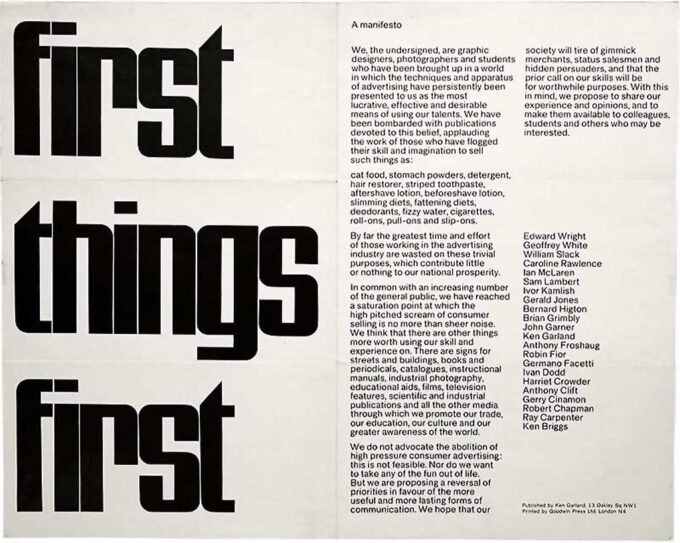


“There is much more to branding than a logo or style. It is a manifestation of power.” –Rodney Abbot, Caps Lock, pg. 131
“It is important to understand the violent part of the history of branding, not just the exceptionally barbarous acts from long ago, but as a fundamental capitalist strategy. The transatlantic slave trade itself was a capitalist enterprise driven by profit that made industrial capitalism possible. Branding reveals the violent logic of capitalism’s exploitation of people and planet, by turning everything into a commodity, even people.” –Ruben Pater, Caps Lock, pg. 136
Well, to begin, let me just say this: It wasn’t the remorseless ubiquity of the word and its loss of all meaning that finally pushed me over the edge with the marketing term “branding” recently. No no. This shift for me—like some various other profound shifts in my life that I can point to (e.g. my vegan dietary practice)—was a long time coming and definitely the result of my commitment to Christian nonviolence. We’ll get back to this in a minute.
When I first heard the term “branding” exploding in “integrated marketing” circles in the early zinds (i.e. the 2000’s) and 10’s I really didn’t like it, partly because I recognized what was going on immediately: in an age of mass production and faceless corporate mono-culture, forging emotional connections with “consumers” is something business people have to try to do and, hey, what better way to do this than to “integrate” the poignant, underlying, visual, and symbolic toolkit from art and design (e.g. logos, marks, color, typography, and the principles of visual identity) that had simultaneously been developing? I see now that “branding” becoming mainly a marketing thing was a natural trajectory in a political-economy like ours. As Pater so clearly indicates above, this term/practice, along with its abhorrent history, emphatically reveals to us the ultra-violent logic of capitalist exploitation.
In his book, Caps Lock: How Capitalism Took Hold of Graphic Design and How to Escape From It, Dutch Graphic Designer, Ruben Pater, traces the etymology of “brand” with a historian’s patience. The word comes from the Old Norse word brandr, which means to burn. The original branding was the searing of a symbol into the hide of an animal with a hot iron, a wooden torch called a brand. This was not metaphor. This was flesh and fire. This was the assertion of ownership over a living being.
And then we did it to each other.
Under Roman law, enslaved people were considered property. Runaway slaves were marked with FGV—fugitivus—while robbers received FUR—fur—burned into the forehead, legs, and arms. During European colonialism, when slavery became an industrial enterprise, the branding iron became a tool of mass administration. Pater details how the Dutch West India Company (WIC) was one of the first multinational corporations to issue brand guidelines, here’s a quick taste:
“as you purchase slaves you must mark them at the upper right arm with the silver marker CCN, which is sent along with you for that purpose…note the following when you do the branding: (1) the area of marking must first be rubbed with candle wax or oil; (2) the marker should only be as hot as when applied to paper, the paper gets red.”
Of course to “brand” something these days usually does not necessitate burning a living creature’s flesh. Thank God (although let’s not fool ourselves, this stuff still happens out there). But let us ask a question often asked by brand strategists themselves: What does a brand ask of us?
In response to this question (and again, from a nonviolent Christian anarchist perspective), we would do well to reflect briefly on the notion of idolatry here. In Christianity, an idol is anything that claims for itself the loyalty, trust, and worship that belong to God alone. Trust me, the prophets did not condemn idols because they were ugly. They commended them because they were competitors, promising what they could never deliver. A “brand” asks us to believe that our identity is something we purchase on the open market rather than something we receive freely. Brands ask us to trust in the consistency of a logo rather than the faithfulness of a God who became flesh and dwelt among us. Brands compel us to worship at the altar of recognition and to offer our attention (which is in many ways the most precious thing we have these days) as a sacrifice to the algorithm. In some real ways when we use the word “branding” as mindlessly and casually as we use the word “design,” we participate in a grammatical act of amnesia. We forget what the word has done. We forget that the same technology used to mark enslaved people as property is now used to mark our souls as inventory.
Interestingly, there is a tradition in Christian ethics of asking what we owe to those who have suffered. For instance, we owe them memory. We owe them truth. We owe them the refusal to make their suffering abstract. When we say “personal branding,” we owe a debt to the person whose skin was seared with the letters FGV. When we say “brand identity,” we owe a debt to the human beings whose arms were marked with CCN before they were sold like cattle. When we say “brand loyalty,” we owe a debt to every creature whose body has been treated as a machine for production, whose life has been reduced to a unit of economic value. We can’t pay these debts with cool logos and fun marketing campaigns but we can at least refuse to contribute to this debt with linguistic forms of erasure.
Look, the desire to be known, to be recognized, to have our identity validated through the things we make is not inherently evil. It is definitely a human longing. But it becomes idolatrous when it is severed from relationship, when it is enacted through control rather than care, and when it treats others as paying audiences rather than beloved neighbors. I am not arguing for the abolition of visual communication. I am not suggesting that organizations should have no way of identifying themselves or that artists should have no way of signing their work. The work of design–the shaping of meaning through image and type and form–is a gift, and it can be a practice of love.
But we do not need the language of burning.
So perhaps we can use our imaginations out there a little bit. If the word “brand” is the language of domination (which it is), maybe we can choose the language of identity? If “branding” is the practice of manufacturing perception (which it is), let’s choose the practice of shaping meaning. If the “brand” is the mark of ownership (which it is), we can choose the word signature, which is the personal, relational mark of one who makes something as an offering. These may not be the best substitutionary words, I admit, but rest assured: the words we use do indeed shape the worlds we inhabit and when we change our words, we change our possibilities. Learning a new language and finding new words that honor the relational fabric of reality is a step toward turning away from the logic of domination and exploitation and a step toward the logic of love, a logic like the one Jesus affirms: where value is inherent, identity is freely received, attention is a form of prayer, and where relationships are gifts that make the Kin-dom of God slightly more possible in the present moment. May it forever be so.