
This is Part 1b of my recent grad school design paper, the introduction can be read here. and Part 1a can be read here.
…
From 1918 to 1992 Yugoslavia improvised their very own “third way” type of economy. In 1948 Josip Broz Tito broke with Stalin and pulled Yugoslavia (which today is comprised of seven countries: Bosnia and Herzegovina, Croatia, Kosovo, Montenegro, North Macedonia, Serbia, and Slovenia) out of the USSR and over the following years the country attempted to implement a decentralized model of workers’ self-management, introduced in 1952, that sat somewhere between the hard-line Soviet command economy and the soft Western market.27 This allowed for a shocking development: advertising in socialist Yugoslavia. Real advertising—posters, trade-fair catalogues, magazine covers, and eventually newspaper and television spots—produced by trained designers, some of them serious avant-garde artists.27
The design historian, Fedja Vukić, reviewed the public collections and private archives of contemporary Croatia (the federation’s most industrialized republic) and arrived at an insight that can be our second data point. Because there was no significant market competition—and therefore “no need for strong distinctions through symbolic values”—Yugoslav firms simply focused on producing goods, and the artists working in “advertising graphics” enjoyed “considerable freedom of expression, exploration and application of innovative communications concepts.”27 Advertising became, to use Vukić’s phrase, a cultural strategy: its job was to welcome industrial modernization itself, to announce to worker-citizens that a more materially dignified life had arrived, rather than to win a symbolic war against a rival brand that did not exist. We might compare this to the Constructivist ending. Where the USSR’s single, total state-client produced the propaganda poster, Yugoslavia’s competition-free arrangement produced something far closer to what Rodchenko had dreamed: design liberated, not abolished.
The clearest proof is Aleksandar Srnec, A founding member of the experimental collective EXAT 51. Srnec was a serious abstract painter and maker of lumino-kinetic objects (see fig. 3) who poured the very same formal research (e.g. abstract compositions and photo-collage) directly into his commercial work; from a 1954 catalogue for an alcoholic-beverages producer to magazine and book covers.28 In the 1950s only two state-owned agencies employed designers, and Vukić notes they granted those designers “a substantial margin of artistic liberty.”28 It is hard not to hear the Constructivist dream echoing here: EXAT 51 had explicitly set out to revive the avant-garde fusion of fine and applied art, of art and life—and in a market without competition, Srnec could be a genuine artist in his advertising precisely because the advertising was not asking him to lie about a difference that wasn’t there.

Figure 3. Aleksandar Srnec’s Luminoplastic 1, 1965–67, in operation. Museum of Contemporary Art, Zagreb.29
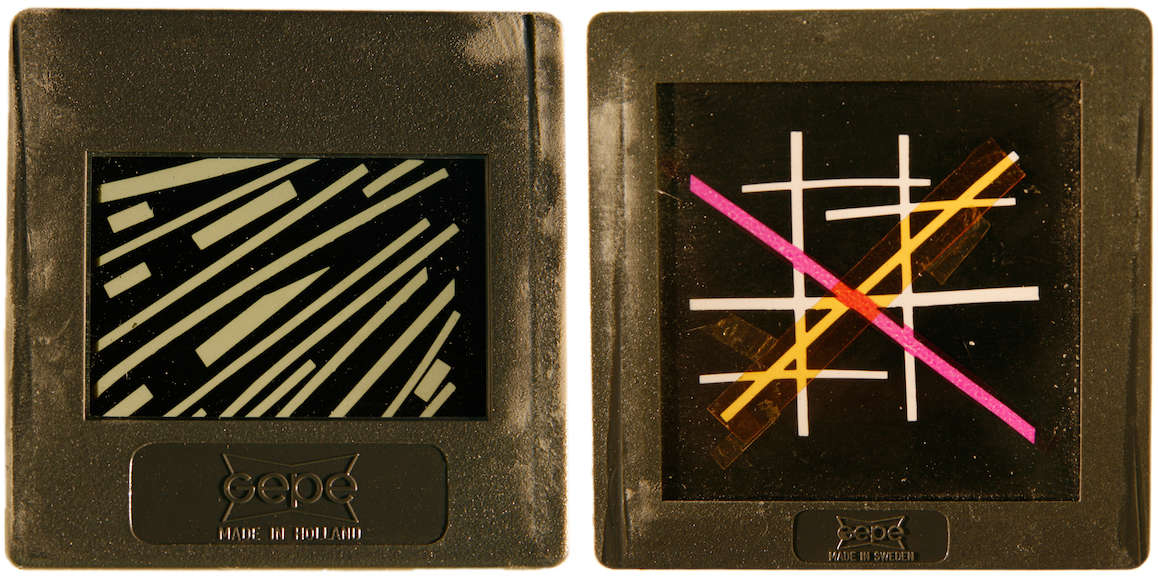
Figure 4. Examples of slides from Aleksandar Srnec’s Luminoplastic 1, 1965–67.Museum of Contemporary Art (MSU), Zagreb.29
In the essay “Designing a Socialist Man” author and designer, Koraljka Vlajo, complicates our Slavic story a bit which, up until now, has been rather hopeful. By drawing on theories from Judith Butler regarding “political performativity,” Vlajo argues that graphic design was one of the Yugoslavian regime’s primary instruments for manufacturing the ideal citizen—the “socialist man”—through the relentless everyday repetition of posters, magazine covers, even matchbox sleeves. “Design,” she insists (paraphrasing Brecht on art), “is not a mirror but a hammer: it does not reflect but shapes.”30 And the ideal Slavic worker’s shape mutated across four decades: from the bare-handed man building the nation in 1945, to the a laughing worker in clean overalls posing before a sunny modern city on the 1974 poster Dan samoupravljača (“Day of Self-Managers”).31 Women, meanwhile, are nearly absent from the political posters and when they appear it is a step behind the men, or, by the time the consumerist sixties arrived, addressed not as citizens but as shoppers—one youth-action poster simply asks women: “What will you wear this summer?”32 The genuinely unsettling lesson we get here from Vlajo (one in which Vukić seems to agree with) is that design’s power to mold identity and desire is not a peculiarity of capitalism. A non-market state seems to have reached for the very same hammer to forge its preferred human being.
Interestingly, Vlajo goes on to explain that the hammer obeys the hand that grips it, and Yugoslav designers did not always grip it as the state wished. The sacred red five-pointed star was drilled into the public eye through “strict and persistent application,” but in the 1960s began to take on “unimaginable connotations,” turning up in the hands of designers like Mihajlo Arsovski and Slobodan Mašić as a glyph of theatre and show business.33 By the 1980s the official symbols are camouflaged, ambivalent, or openly subverted by being normalized to the point of banality, which stripped them of their “sacred” ideological weight. Vlajo’s conclusion is that the regime’s own ubiquitous, repetitive design machine is precisely what made its symbols vulnerable to contamination, so that in the end “even the seemingly loyal political poster contributed to the downfall of a dominant narrative.”34
So Yugoslavia hands us a double sided lesson. On the hopeful side: remove the competitive market and design need not die or curdle into propaganda—it can be released into genuine experiment, and even advertising can be repurposed as a cultural strategy announcing shared progress rather than waging brand warfare. On the cautionary side: design is a hammer, not a mirror, an instrument for shaping human beings that will serve whatever hand grips it, state or market. The freedom of the Yugoslav designer was real, but so was their capacity to manufacture an “ideal citizen” on command. Just as real was their capacity to turn the same tools against the narrative they were hired to reinforce. One takeaway for the future we are chasing could be that design is liberated only when the hand on the hammer is genuinely plural, democratic, and free to be self-critical—a condition that our next, still-living laboratory, contemporary Cuba, will test under the harsh light of the present day.
…
27. Fedja Vukić, “Advertising Design as Cultural Strategy,” Proceedings of the 9th Conference of the International Committee for Design History and Design Studies (December 2014): 273. On Yugoslavia’s 1948 break with the Soviet bloc and the introduction of workers’ self-management in 1952, see 274, 277.
28. Vukić, “Advertising Design as Cultural Strategy,” 275. On Srnec’s experimental practice and his role in EXAT 51, see also Fedja Vukić, “Present Absence: Aleksandar Srnec’s Personality and Artistic Oeuvre in the Context of the Industrial /Socialist/ Modernisation of Society,” in Present Absence, ed. M. Sudac (Zagreb: Edicija Sudac, 2007), 363–68.
29. Mirta Pavić and Vesna Meštrić, “Preserving Performativity: Conserving the Elusive in Aleksandar Srnec’s Artwork,” in *Keep It Moving?: Conserving Kinetic Art*, ed. Rachel Rivenc and Reinhard Bek (Los Angeles: Getty Conservation Institute, 2017), fig. 8.3, https://www.getty.edu/publications/keepitmoving/collections/8-pavic_mestric/.
30. Koraljka Vlajo, “Designing a Socialist Man,” AM Journal of Art and Media Studies, no. 19 (October 15, 2019): 16, https://doi.org/10.25038/am.v0i19.314. On graphic design and “political performativity”—the continuous reassertion of regime authority through everyday visual reiteration—Vlajo draws on Reuben Rose-Redwood and Michael R. Glass and, behind them, Judith Butler (15–16).
31. Vlajo, “Designing a Socialist Man,” 19.
32. Vlajo, “Designing a Socialist Man,” 21.
33. Vlajo, “Designing a Socialist Man,” 17.
34. Vlajo, “Designing a Socialist Man,” 22; on the “Let us change in order to not be replaced” slogan of the 1986 SSO Serbia congress poster, see 21.



Pingback:Designing for Beauty, Sufficiency, and Collective Care – Part 1c: Design in Cuba: Sufficiency and Resourcefulness in Action
Pingback:Designing for Beauty, Sufficiency, and Collective Care – Part 2a: What is Degrowth?
Pingback:Designing for Beauty, Sufficiency, and Collective Care – Part 2b: What is Solarpunk?
Pingback:Designing for Beauty, Sufficiency, and Collective Care Part 3a: Imagining the World of The Post-Capitalist Designer – What has changed?