
This is the second section in Part 2 of my recent grad school design paper in which I explore two contemporary, post-capitalist movements that have much to offer our creative endeavor to imagine a new, ecologically sensitive design story. Degrowth and solarpunk are neither finished experiments nor cautionary tales but living, still-unfolding proposals, argued over in real time by economists, novelists, and organizers who have not yet had the chance to get it wrong at scale. If taken together, they might really offer designers something the twentieth century’s non-capitalist laboratories could not: a vision of post-capitalism being authored collaboratively, in the open, before any state or market has had the opportunity to co-opt it for its own purposes.
Please find the preceding sections of the paper below if you’d like to catch up:
Part 1a: The Designed Object as Comrade in Constructivist Russia
Part 1b: Advertising as Cultural Strategy in Socialist Yugoslavia
Part 1c: Design in Cuba: Sufficiency and Resourcefulness in Action
Part 1d: The Design Institutes of China
…
What is Solarpunk?
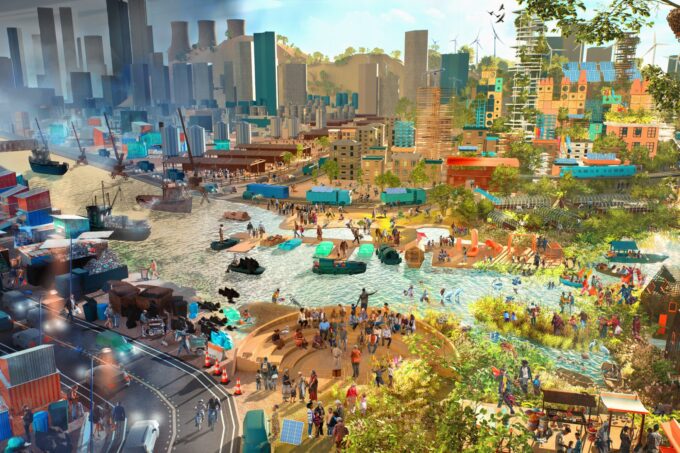
If degrowth is the structural engineer, calculating the precise load-bearing capacity of our abused ecosystems, then solarpunk is the architect who turns limits into liberation by designing hanging forests and shimmering solar-cathedrals. The UK writer and podcaster Jay Springett, who has been part of the community for a decade, describes solarpunk simply as “a container for ideas about the future.”68 In that tupperware container you will find things like vertical forests and rooftop gardens and wind turbines, water tanks, kept chickens, an unused red phone box which was converted into a neighborhood seed library, and (Springett’s personal favorite) the humble clothesline.69 It is a vision of the future that is, charmingly, often already sitting in somebody’s backyard.
The word solarpunk sums itself up in miniature. “Solar” signals optimism and a turn toward renewable energy and the living world; “punk” brings the do-it-yourself ethos and packs an anti-capitalist bite.71 Phoebe Wagner and Brontë Christopher Wieland discuss in their book about solar punk futures that the movement began online around 2008 “but became more widely recognized with the publication of Solarpunk: Histórias ecológicas e fantásticas em um mundo sustentável, edited by Gerson Lodi-Ribeiro, in 2012 and Adam Flynn’s ‘Solarpunk: Notes toward a Manifesto’ in 2014.”72 Throughout this time solarpunk has defined itself against its more depressing older sibling, cyberpunk. Where cyberpunk gives us Blade Runner’s permanent acid-rain midnight and a world of “high tech, low life,” solarpunk insists on the warmth of a sunny day and on people “learning to live in balance with one another in the process of learning to live in harmony with the world.”73 Crucially, solarpunk is not naïve utopianism. As Wagner and Wieland observe, the early solarpunks rejected the post-9/11 fashion for dystopian hopelessness without jumping to the opposite extreme; they aimed instead for “something in the middle, such as the ambiguous utopias of Ursula K. Le Guin’s work. The goal of solarpunk is not to dream of perfect worlds but to strive for something sustainable and just in the Anthropocene.”74
 Figure 6: A) Cover art for The Dispossessed: An Ambiguous Utopia by Fred Winkowski, New York: Harper & Row, 1974. B) Cover art for The Word for World is Forest by Richard M. Powers, New York: Berkley Books, 1976. C) Cover art for Always Coming Home by Margaret Chodos, New York: Harper & Row, 1985.
Solarpunk’s criticism of our current political-economy overlaps heavily with degrowth’s. Global governance researcher, William Gillam, distills solarpunk’s three guiding principles down to: anarchism, ecology, and justice.75 As a stream of anarchist thought, solarpunk is post-capitalist and post-scarcity, suspicious of hierarchy and domination and fond of horizontal forms of organization as well as things like mutual aid and the local over the global.76 As an ecological imaginary, it refuses the old Cartesian dualism story in which nature is an objectified resource to be mastered, and seeks instead to reintegrate human and ecological systems.77 Finally as a movement that takes justice seriously, it increases the scope of moral concern across class and identity, across generations, across communities, and beyond the human altogether.78 These three principles contain the same refusal that drives degrowth: a flat rejection of the “no future” nihilism of classic punk and of the capitalist realism that insists no other world is possible.
So what does solarpunk ask of a designer? Perhaps more so than any movement discussed in this paper, solarpunk offers us some helpful ideas. Navarre Bartz, writing in Almanac for the Anthropocene, offers a set of straight forward questions for the solarpunk designer that could be pinned above any studio doorway:
-
- Would you let kids play with it? Bartz correctly suggests that including things in a design that may be harmful to children can only be done with good reason, and “Making the product cheaper or easier to manufacture is not a good reason.” 79
- Did you make it circular—not merely “less bad” but, in McDonough and Braungart’s phrase, “more good”? According to Bartz this means that “you’re actively ensuring that the production, use, and disposal of your design is a positive for the environment around us.”79
- Could you accomplish the task with less? Bartz smartly recommends neither avoiding technology or blindly swallowing it but seeking the minimalist road of “using the appropriate technology for the job” and not “endlessly…developing a product for its own sake.”79
- Are you focused on the object or the person? Bartz recommends that solarpunk designers “look at the whole picture of how a product or system will be used in order to provide the best outcome for the person using it.”79
- Are you taking a systems approach? A holistic systems approach to design for Bartz seems to view projects as interconnected networks rather than isolated parts.79
Importantly, Bartz argues that solarpunk design is “a minimalist approach to technology” and is neither primitivism nor techno-optimism.80 “Minimalists,” Bartz continues, “focus on identifying the things that are truly important to them and intentionally…[add] only those things to their lives. It’s not about giving things up but about being intentional in what we include.”80 The designer Matthew Wizinsky, who has taught solarpunk design to architecture students, helpfully frames the discipline this way: solarpunks are “taking existing knowledge, distributing that knowledge and encouraging broader participation in how we live our everyday lives.”81
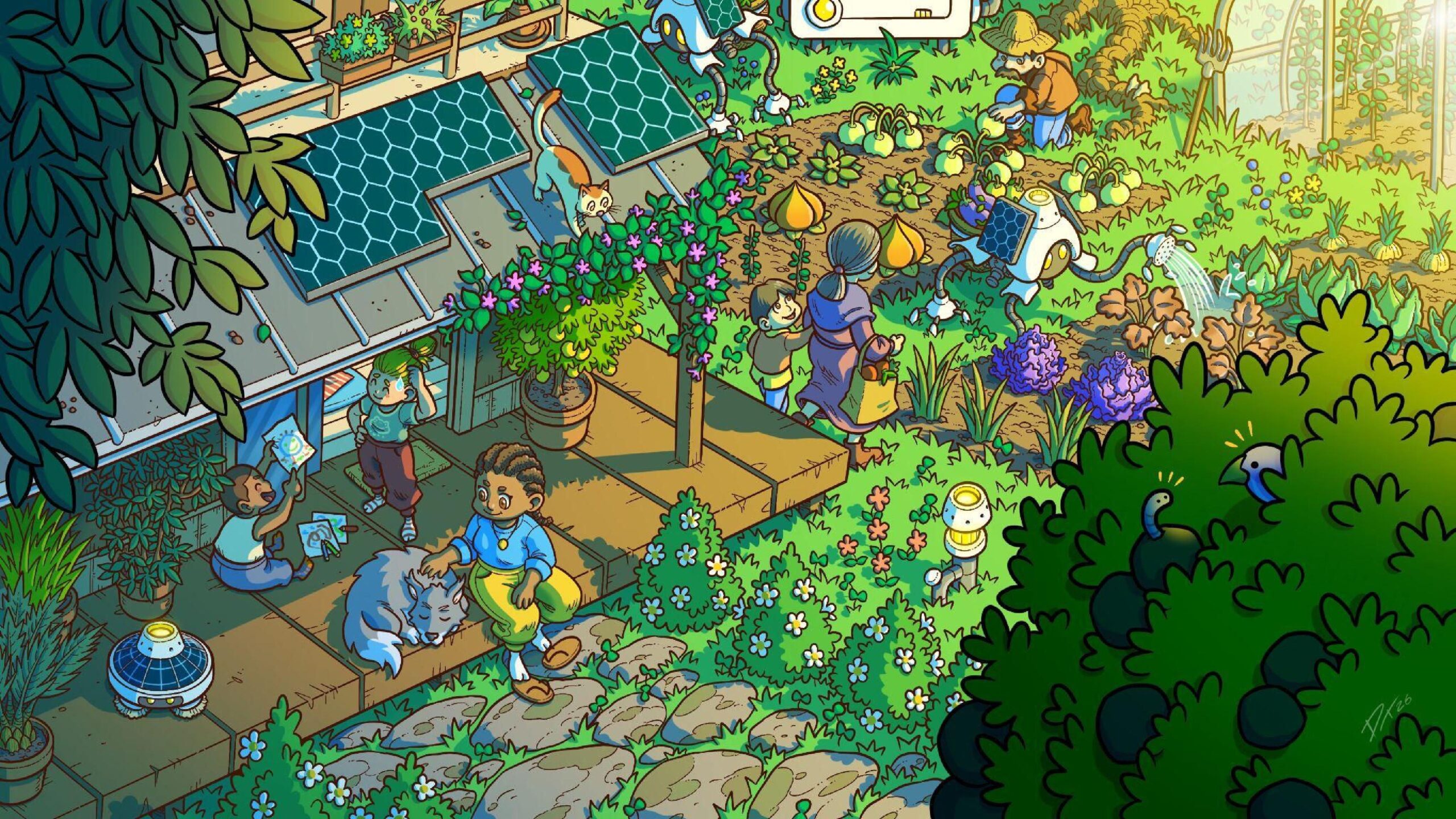
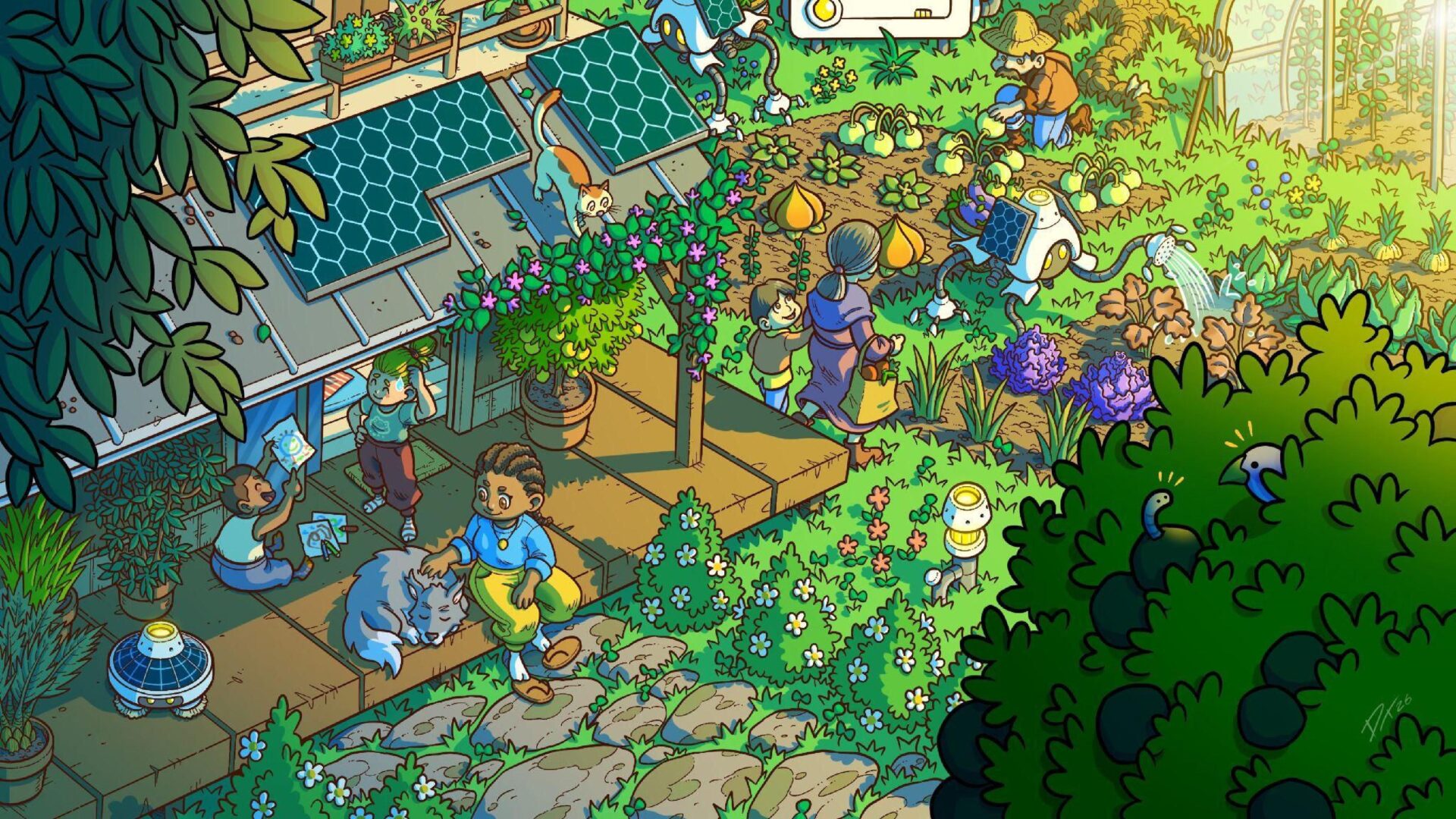
Illustration credit: Story Seed Library – This image by Italian illustrator, Daniele Turturici, depicts “shared gardens within cities where anyone in the community can plant and grow food freely, for everyone’s benefit, with the support of solar-powered robots. Spaces to gather, connect, and spend some relaxing time together, where workshops for children and other community activities can also be organized. A service by the community, for the community.”
When it comes to solarpunk, perhaps the most important take away for designers is that it insists on the leap from imagination to action. In the conclusion to their book, Wagner and Wieland worry that the movement has spent too long “waiting and hoping for a piece of solarpunk literature or media to go mainstream,” longing for a “solarpunk bible,” when what is actually needed is to “show up wherever, whenever, and however we can.”82 Wagner and Wieland wisely urge us to constantly be aware that stories “help us envision, imagine, critique, and normalize other ways of being, but so do direct actions… [they are] sides of the same coin.”83 For a designer, this might mean the deliverable is not a handsome poster about a better world, but a small, working, repairable, sharable piece of one.
…
Notes
68. Jay Springett, quoted in Nicola Heath, “Solarpunk Started Out as a Speculative Fiction,” Australian Broadcasting Corporation, April 6, 2024.
69. Heath, “Solarpunk Started Out as a Speculative Fiction.”
70. Heath, “Solarpunk Started Out as a Speculative Fiction”; see also William Joseph Gillam, “A Solarpunk Manifesto: Turning Imaginary into Reality,” Philosophies 8, no. 4 (2023): 73, https://doi.org/10.3390/philosophies8040073.
71. Heath, “Solarpunk Started Out as a Speculative Fiction”; see also William Joseph Gillam, “A Solarpunk Manifesto: Turning Imaginary into Reality,” Philosophies 8, no. 4 (2023): 73, https://doi.org/10.3390/philosophies8040073.
72. Brontë Christopher Wieland and Phoebe Wagner, eds., Almanac for the Anthropocene: A Compendium of Solarpunk Futures (Morgantown: West Virginia University Press, 2022), 2.
73. The quoted contrast is from I. Johnson”Solarpunk & the Pedagogical Value of Utopia” (2010), quoted in Rikke Toft Nørgård and Kim Holflod, “(No) Hope for the Future? A Design Agenda for Rewidening and Rewilding Higher Education with Utopian Imagination,” International Journal of Educational Technology in Higher Education 21 (2024): 11; on the Blade Runner aesthetic and its dismay to “actual cyberpunks,” see also Wagner and Wieland, “The Situation So Far,” 3.
74. Wagner and Wieland, “The Situation So Far,” 2.
75. Gillam, “A Solarpunk Manifesto,” 1, 3.
76. Gillam, “A Solarpunk Manifesto,” 3–5. On post-scarcity anarchism and its debt to Murray Bookchin, Kropotkin, and Schumacher, see 3–4.
77. Gillam, “A Solarpunk Manifesto,” 5–7, on the rejection of Cartesian dualism and the turn toward eco-anarchism and post-humanism.
78. Gillam, “A Solarpunk Manifesto,” 8–9, on the four pillars of justice: social, generational, cross-community, and non-human.
79. Navarre Bartz, “Solarpunk Design Guidelines,” in Almanac for the Anthropocene, 80–82; on designing for “more good” rather than merely “less bad,” Bartz draws on William McDonough and Michael Braungart, Cradle to Cradle: Remaking the Way We Make Things (New York: North Point Press, 2002).
80. Bartz, “Solarpunk Design Guidelines,” 79, 81.
81. Matthew Wizinsky, quoted in Heath, “Solarpunk Started Out as a Speculative Fiction.”
82. Phoebe Wagner and Brontë Christopher Wieland, “Looking Forward,” in Almanac for the Anthropocene, 195–96.
83. Wagner and Wieland, “Looking Forward,” 196.

Pingback:Designing for Beauty, Sufficiency, and Collective Care Part 3a: Imagining the World of The Post-Capitalist Designer – What has changed?
Pingback:Designing for Beauty, Sufficiency, and Collective Care Part 3b: Imagining the World of The Post-Capitalist Designer – Identifying Post-Capitalist Design Needs