“This creates the series of questions Pluribus forces us to confront in every episode: Is our freedom—our autonomy—really too high a price to pay in exchange for global happiness and organized, respectful survival on our planet? If we accept the implied thesis that a free human will inevitably destroy the planet and themselves, is the alternative…
Posts Tagged
process philosophy
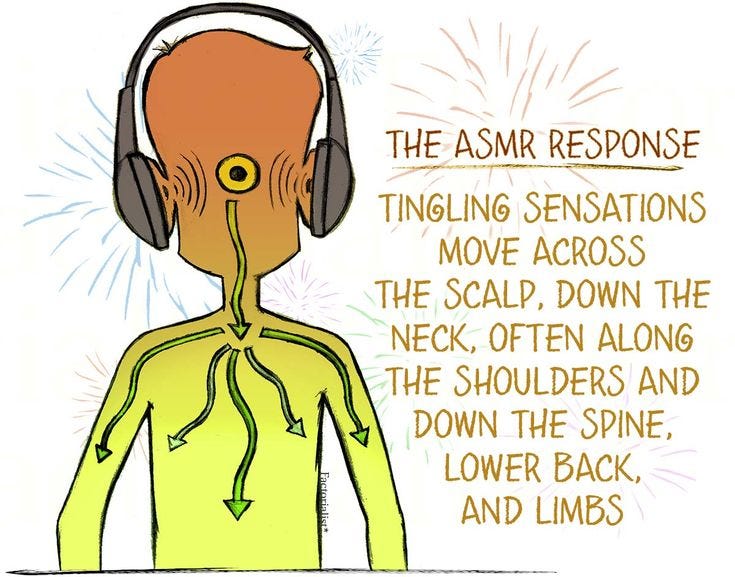
The Ordinary Texture of Existence: Reflections on ASMR and The Consummatory Satisfaction of Felt Quality
“Whisper whisper whisper.” –Anonymous ASMRtist old pond– frog jumps in. Plop! –Matsuo Bashô “In Whitehead’s analysis of an occasion of experience, the “category of transmutation” (PR 63) describes how the felt qualities of past events are fused into a new event with the consummatory satisfaction of an emergent pervasive aesthetic quality. […] Whitehead’s “satisfaction” is identified…
Erosion of Process Directly Erodes Comprehension: Reflections on AI, Skeuomorphism, and the Creative Process
“Be “dialectical” just for one minute: imagine a world where there is no point in teaching people things, the process of education is replaced by The Answer (no shade to Allen Iverson). You just… ask for the answers without regard to the process of making answers. Come on. Aren’t you imagining… Hell? Do we just…
Each Occasion is Concerned With The Universe: Virtuous Oscilation, Whitehead, and Quaker Concernedness
“Consciousness flickers; and even at its brightest, there is a small focal region of clear illumination, and a large penumbral region which tells of intense experience in dim apprehension.” –Whitehead, Process and Reality “An exemplar can exemplify only some of its properties. It brings those properties to the fore by marginalizing, downplaying, or ignoring other…
I Hate COPS Because I Love COPS
“As an occupation, policing necessarily involves people in a violent institution, demands they forfeit their freedom to a hierarchical chain of command and constraints imposed by their oath of office, and asks them to participate in an idolatrous view of the nation-state as the place where God’s action in history is primarily to be experienced…
Losing Oneself: Brief Reflections on Identity, Roles, and Alienation
“Although the social structures in the contemporary world are less rigid than in ancient cultures, there are still many pre-established functions or roles that people readily identify with and which thus become part of the ego. This causes human interactions to become inauthentic, dehumanized, alienating. Those pre-established roles may give you a somewhat comforting sense…
Not a Simple Sum of Interchangeable Parts: Substitutability and Rational Order vs. Aesthetic Order
“Our word “reason” goes back to the Greek verb lego, the verbal noun of which is the famous word logos, which was translated as the Latin ratio. Lego has two principal meanings: “to say” (hence the Word of John’s logos) and “to put together” (related to lechos as the marital couch). (As Whitehead states: “Logic…
Improvising is All About Human Relationship: Whitehead and Nachmanovitch
“Improvising is all about human relationship. It is about listening, responding, connecting, and being generous. When a group of free players gets together and unfolds a coherent and interesting piece without a prior plan or template, it is like watching separate beings become integrated into a single nervous system. It is a partnership, with each…
Brief Reflections on Intellectual Effort as Private Property and Economic Commodity, Copyright, and The Social Activity Called Art
“’Authorship’ – in the sense we know it today, individual intellectual effort related to the book as an economic commodity – was practically unknown before the advent of print technology. Medieval scholars were indifferent to the precise identity of the “books” they studied. In turn, they rarely signed even what was nearly their own. They…
Something that stands for something, to someone in some capacity: signs, meaning, intentionality
“The actions of billiard players, people in general, nonhuman animals, and even plants when seen in the right time frame, are patently intentional, both in the more precise sense used by philosophers in the line of Husserl and Merleau-Ponty, and in the more everyday sense referring to an act carried out for some purpose, something…