
“Rodchenko names a new kind of emotionally affective object: the comradely object of socialist modernity. Unlike the commodities he encounters on his visit to capitalist Paris, which elicit a possessive relation that makes the objects into “slaves,” things made in the socialist East will actively promote egalitarian socialist culture. They will replace the pleasure of commodity possession, not with its presumed Communist opposite of material renunciation, but with something far more peculiar and psychologically powerful: the material object as an active, almost animate participant in social life.” –Christina Kiaer10
“Men and women have constantly intervened in nature, but for a long time this meant being in tune with and respecting the possibilities offered by the things themselves. It was a matter of receiving what nature itself allowed, as if from its own hand. Now, by contrast, we are the ones to lay our hands on things, attempting to extract everything possible from them while frequently ignoring or forgetting the reality in front of us. Human beings and material objects no longer extend a friendly hand to one another;” –Pope Francis, Laudauto Si’102
I’ve been busy this summer writing a paper for grad school about degrowth, solarpunk, and what graphic design might look like in an economy not organized around competitive markets or infinite growth. I’ll post the entire paper soon but below is a section of the paper I had a lot of fun writing; inspired by Rubin Pater’s book Caps Lock, in Part III of the paper I imagine three roles that make up what I call the Regenerative Commons Designer and below is the first of them: the designer as moral compass, oriented toward beauty, sufficiency, and collective care.
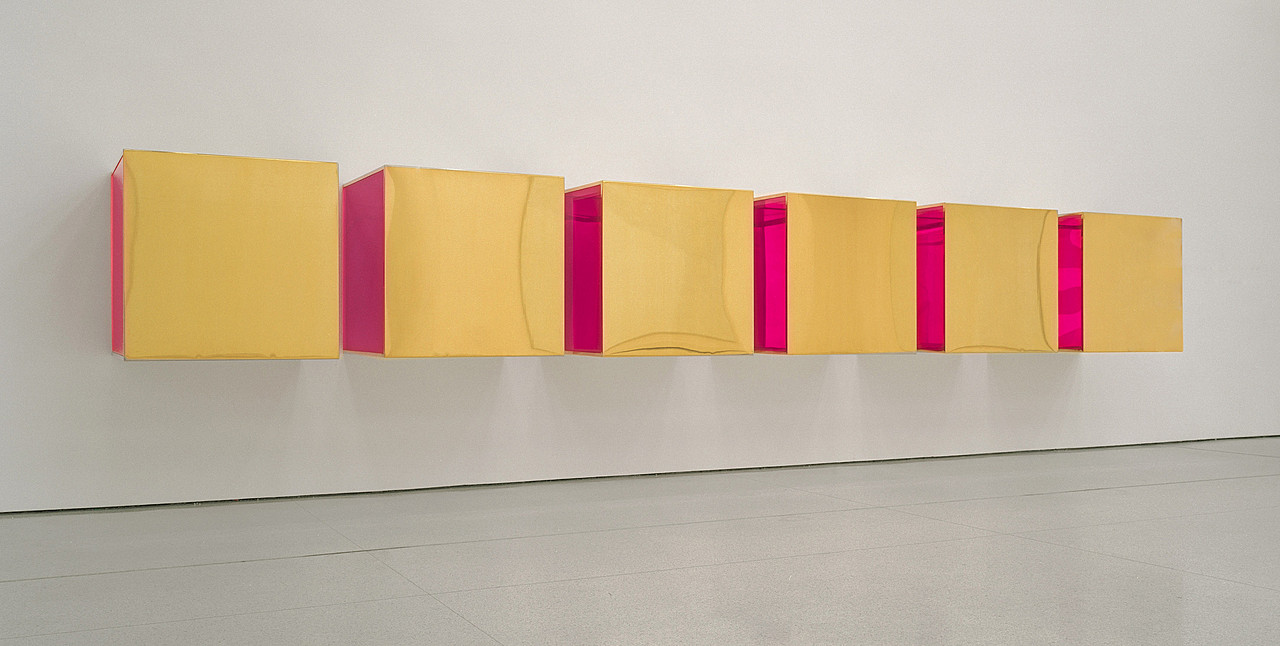
As a discipline that blends science and art, one reason design might fall short of being considered a hard science is precisely because of its sensitive artistic intuition. This could mean that designers can more easily embrace some of the aesthetic-spiritual traditions that have long taught human beings how to distinguish between things like sufficiency and excess or reverence and acquisitiveness. Minimalism, for example, was an art movement that emerged in 1960s America as a reaction against the excess of Abstract Expressionism, prizing the right angle, the cube, and a “minimum of compositional manipulation”— basically, the idea was to shoot for literal nonreferential objecthood over illusion and ornament.103 But minimalism as a design ethic reaches back further than Donald Judd’s painted boxes (pictured above105), drawing on centuries of contemplative traditions linking the emptying of physical space to the filling of inner life. Zen aesthetic principles, as scholars Yan Jia and Muhammad Firzan explain, “aim to create a pure and simplified environment that harmonises the tangible and intangible elements. The philosophy of ‘form is emptiness, emptiness is form’ is exemplified through the use of minimalist, unadorned spaces, wherein physical emptiness enriches spiritual abundance.”104
In the West we find another group known for their minimal spiritual-aesthetics that the Regenerative Commons Designer might learn from. Quakers arrived at a strikingly similar conclusion to the Zen practitioners but by an entirely different theological route. As Peter Collins argues in their essay “Quaker Plaining as Critical Aesthetic,” the Quaker testimony of simplicity is not merely a preference for grey over color but a critique — “the plain has most often been invoked in order to curb the excesses of the influential, the dominant, the powerful,” functioning as “a moral, aesthetic and religious critique of consumer culture.”106 In fact early Friends did more than just slap stickers over their apple laptop logos, they went as far as to ban superfluous ornament in dress, speech, and worship on the conviction that “simplicity is spiritual detachment from the [possession by] things of this world.”107 Once again the warning seems clear: our possessions can very well possess us.
One more example of a spiritual-aesthetic tradition that any designer as moral compass (now or in the near-distant-future) may draw from can be found secularized and commercialized in the global popularity of Marie Kondo, whose KonMari Method borrows its emotional impact from Shinto animism. Kondo trained for five years as a miko, or shrine maiden, and The Economist notes that her signature practice of thanking discarded objects “is said to be inspired by Shinto’s emphasis on process and ritual.”108 Folklorist Amelia Mathews-Pett situates Kondo’s practice within a broader, often unconscious Western animism, arguing that the “Japanese kuyō ritual of ceremonially thanking exhausted possessions” before disposal offers “a model for performing responsibility and respect” that officially non-animist Western consumers instinctively crave.109
For the Regenerative Commons Designer, one lesson embedded across these spiritual-aesthetic traditions (Quaker, Zen, Shinto) is the same one Alexander Rodchenko reached for in his letters from Paris a century earlier: objects, whether kept or released, are never merely inert commodities but comrades, animate participants in a shared life, deserving neither idolatrous worship nor careless disposal but honest, respectful relation.110 The designer as moral compass, then, who is forever oriented toward beauty, sufficiency, and collective care, strives to bring this same reverence to whatever they make, resisting the manufacture of desire, and designing instead objects a community can live alongside with as equals.
…
10. Christina Kiaer, Imagine No Possessions: The Socialist Objects of Russian Constructivism (Cambridge, MA: MIT Press, 2005), Introduction
103. Genevieve Slomski, “Minimalism Emphasizes Objects as Art,” Salem Press Encyclopedia, 2023, 1.
104. Yan Jia and Muhammad Firzan, “Exploring the Zen Aesthetic Principles in the Design of Tea Rooms in Hebei Province, China,” Buildings 14, no. 11 (2024), sec. 3, “Design Principles of Zen Aesthetic Tea Rooms.”
105. Donald Judd, Untitled, 1961, liquitex on canvas, 122 x 244 cm, Solomon R. Guggenheim Museum, New York.
106. Peter Collins, “Quaker Plaining as Critical Aesthetic,” Quaker Studies 5, no. 2 (2001): 121–139, at 131.
107. Quaker Faith and Practice (1995), 20.27, quoted in Collins, “Quaker Plaining as Critical Aesthetic,” 122–23.
108. “Through the Looking Glass; Japan and Shinto,” The Economist 431, no. 9141 (May 4, 2019): 35.
109. Amelia Mathews-Pett, “I Want It to Go to a Good Home: Animism in Western Relationships with Personal Possessions,” Performance Research 24, no. 6 (2019): 86–94, at 91.
110. Christina Kiaer, Imagine No Possessions: The Socialist Objects of Russian Constructivism (Cambridge, MA: MIT Press, 2005), 1–7; see also note 21 above.