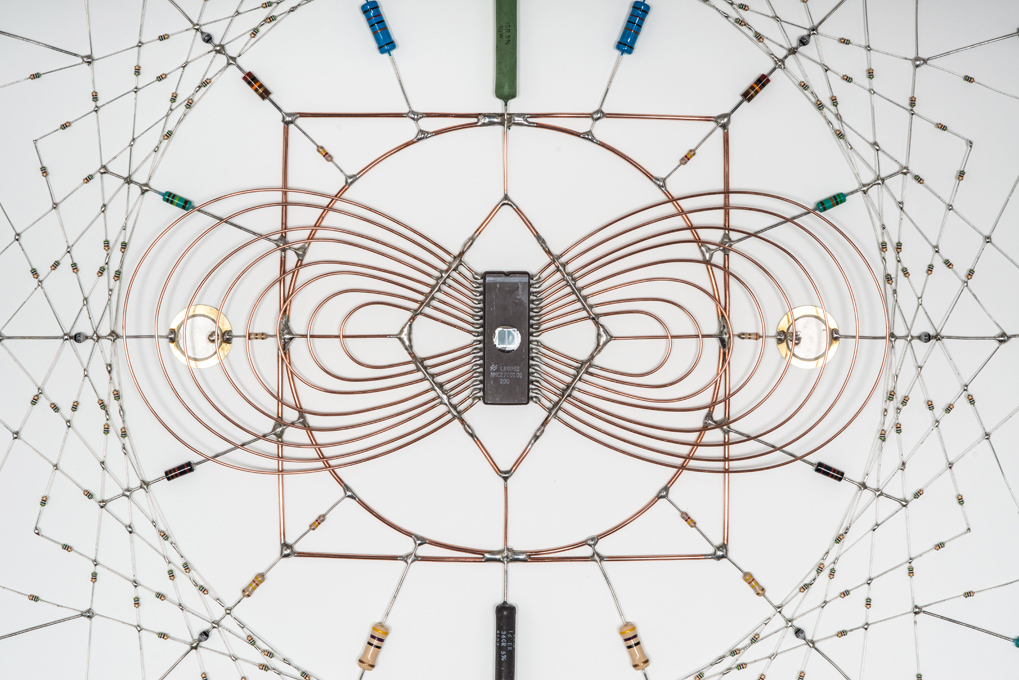
“As even Clayton himself has argued, there are “questions that science raises but cannot answer using its own resources.” In particular, he views quantum physics “as notorious for confronting us with philosophical questions that physics itself may never be able to answer…” This is where what Clayton calls a “hypothetical, pluralistic” metaphysics (like Barad and…
Category
Art
The Unity of Person is a Unity of Experience- Richard Rescher and Process Psychology
The self or ego has always been a stumbling-block for Western philosophy because of its resistance to accommodation within its favored framework of substance-ontology. The idea that ‘the self’ is a thing (substance), and that whatever takes place in ‘my mind’ and ‘my thoughts’ is a matter of the activity of a thing of a…
To Love Someone is To Be Affected by Them
“Most disturbingly, if unilateral power is the ability to remain safely unaffected by others, then unilateral power seems to be the opposite of love in one important respect. For surely, to love someone is to be affected by them. The more deeply we love someone the more we are affected by them. Their joys and…
What you make out of what you have received is who you are // More Bernard Loomer – on Self-Creativity
“In the relational viewpoint you begin life as an effect produced by the many others in the world of your immediate past. But you are not simply a function of these relations. You are an emergent from your relationships; and in the process of your emergence you also create yourself. Your life as a living…
Try to conceive of beauty and you will become a “bumbling” fool: good art, bad art and ontological vagueness
I went to a great talk last night which featured Dr. Aaron Meskin, Associate Professor of Philosophy at the University of Leeds. His aesthetic research is really interesting. It addresses such topics as the effects of exposure to bad art and the nature of aesthetic adjectives such as ‘beautiful’ and ‘ugly’. Basically, what I took…
Patriarchy and the Alphabet: Goddess Worship, Marshall McLuhan, and The Conflict Between Word and Image
“The Old Testament was the first alphabetic written work to influence future ages. Attesting to its gravitas, multitudes still read it three thousand years later. The words on its pages anchor three powerful religions: Judaism, Christianity, and Islam. Each is an exemplar of patriarchy. Each monotheistic religion features an imageless Father deity whose authority shines…
We are from the start outside ourselves // Carol Bigwood on Intersubjectivity
…We exist simultaneously in cultural and natural ways that are inextricably tangled. We are always already situated in an intersubjective (and thereby already cultural), spatiotemporal, fleshy (and thereby already natural) world before we creatively adopt a personal position in it. Moreover, nothing determines us from the outside or inside, precisely because we are from the…
Recognizing unity is primarily the job of art, not the job of science
In other words, for a system or structure to maintain its integrity as it becomes more complex, it must become more unified — each part of the system must work together with a large number of other parts, and together with the system as a whole. But it is, perhaps, predictable that scientists have tried…
Our poetry is our haunting and adventure / More Dean Young
Poetry is a manifestation of the spirit as it triangulates itself through the desires and limitations of meat; meditative inklings of immortality, and the play in the manipulation of aestheticized materials. It forgets about itself as code making, has the supreme confidence of handling elemental fuels. The word then is not only fit referent but…
Dialectics: The Art of Refutation and the Quintessential Method for Ascertaining Knowledge
The notion of process, activity, or change has an inextricable relation to the nature and meaning of dialectic. In ancient philosophy, dialectic (dialektik‘), derived from the Greek dialegein, meaning to ‘converse,’ ‘argue,’ or ‘discourse,’ involved a conversational method of argumentative exchange. By Plato’s time, the term acquired a technical sense in the form of question…