
The Ordinary Texture of Existence: Reflections on ASMR and The Consummatory Satisfaction of Felt Quality
“Whisper whisper whisper.”
–Anonymous ASMRtist
old pond–
frog jumps in.
Plop!
–Matsuo Bashô
“In Whitehead’s analysis of an occasion of experience, the “category of transmutation” (PR 63) describes how the felt qualities of past events are fused into a new event with the consummatory satisfaction of an emergent pervasive aesthetic quality. […] Whitehead’s “satisfaction” is identified by Pepper as the enjoyment of immediately felt aesthetic quality emerging from the purposive act of self-creativity.” –Steve Odin, Tragic Beauty in Whitehead and Japanese Aesthetics, pg. 113.
I am still working my way through Steve Odin’s masterful work (quoted above) and was delighted to encounter a thinker profiled in chapter eight named S.C. Pepper (that’s right, Dr. Pepper! But not the one you’re thinking of), who Odin describes as being “deeply influenced by Whitehead’s metaphysics of qualitative immediacy.” Reflecting on this helpful interpretation offered by Pepper (via Odin) of Whitehead’s concept which he termed an ‘actual occasion of experience’ (AKA: the units of reality in Whitehead’s thought) being alternatively understood as a creative event with directly felt pervasive aesthetic quality immediately (and inexplicably) brought to mind the YouTube subculture we all know and love: ASMR. It stands for Autonomous Sensory Meridian Response and is associated with the pursuit of a distinct tingling sensation triggered by ordinary or mundane things like a soft voice whispering in a microphone, or a brush gliding through hair, or even fingertips tapping rhythmically on wood. I began to ask: could this contemporary and admittedly bizarre (especially to the uninitiated) digital phenomenon known as ASMR be an example of both the Zen insight that Bashô’s haiku above is getting at and Whiteheadian consummatory satisfaction? Perhaps.
The Whisper That Travels the Spine
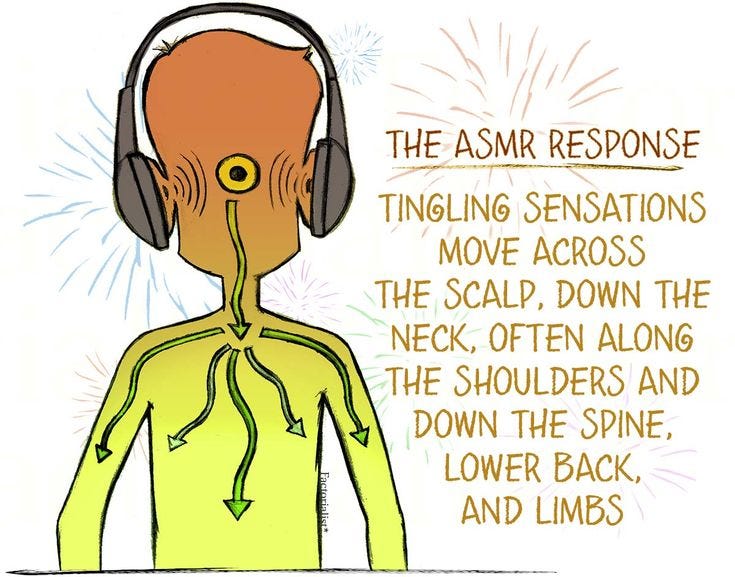
Based on the ASMR wikipedia entry, and this NYT article by Jamie Lauren Keiles, one can safely surmise that the digital life of ASMR began in 2007 with an online post seeking others who felt a calming tingle that traveled the spine resulting from mundane sights and sounds—a sensation writers like Virginia Woolf had described decades earlier. So we can safely assume this phenomenon has been around for a while. This spark ignited a global online community, leading to the formal coining of the term “Autonomous Sensory Meridian Response” in 2010. The rise of YouTube transformed it from a shared curiosity into a creative genre, with “ASMRtists” intentionally crafting whispers, taps, and role-plays to architect that specific physical response.
We all pretty much know the story from here. As is so often the case, what began on niche forums soon resonated in laboratories and pop culture. Initial skepticism of ASMR gave way to fMRI studies investigating its neural basis, while its potent aesthetic and therapeutic appeal propelled it into Super Bowl commercials, art museum exhibitions, and mainstream cinema. Like it or not, this journey seems to mark ASMR’s evolution from an obscure internet whisper to what is now a widely recognized phenomenon.
Personally speaking, when I first became aware of this phenomenon fairly early on in it’s formation (I’ve been traipsing around the internet for some time now!) I resonated with ASMR immediately as a form of sound design, and understood how some of the more popular triggers could be very satisfying. For me it was mostly the audio-related things that were appealing: the crackling of a wood fire burning for instance, or computer keyboard keys clicking. I also quickly realized that focussing on and enjoying these sorts of mundane sights/sounds/feels was something I’ve been doing my entire life as a creative person, and although watching ASMR videos is not something I do much of at all I must confess: one of my all-time favorite ASMR-like activities (going back to childhood) is to quickly flip through book pages, holding the book with my thumb and fore finger while sniffing the flipped pages as they pass. Sure enough, upon searching YouTube for ‘page turning ASMR videos’ (purely as research for this article of course) I found some very satisfying stuff!
Skip ahead to today and, upon further reflection on ASMR filtered through a Whiteheadian “process metaphysics of qualitative immediacy” (to use Odin’s phrase), I do find myself wondering if these paresthesian “tingles” can be helpfully understood as designed occasions aiming for one thing: consummatory satisfaction.
The Consummatory Satisfaction of Felt Quality
In Chapter Eight of Odin’s book he attempts to build a bridge between Eastern and Western philosophical traditions by focussing on the theme of aesthetic quality as qualitative immediacy. In other words, the concept of directly felt experiences of events in their “suchness” (as a Zen Buddhist might say) is, according to Odin, central to both the American process philosophy of Whitehead, Dewey, James et. al and certain Asian philosophies like Zen Buddhism which emphasizes the idea of shunyata (emptiness) interpreted as the vivid, immediate quality of phenomena. This part of Odin’s book details five American thinkers ( Pepper, Northrop, Pirsig, Weiman, Langer) who where all influenced by Whitehead and who each sort of realized this connection to Asian philosophy and art in their own way. Throughout chapter eight Odin—in different ways, using different thinkers—restates one of Whitehead’s main ideas: reality is fundamentally made up of aesthetic experiences. Not atoms, not ideas, but moments or drops of feeling.
To sum up quickly, Whitehead’s concept of an “actual occasion” is critical to his thought system; it is Whitehead’s basic unit of reality. Each occasion is a drop of experience, a creative event that feels the world and synthesizes it into something new. The culmination of this process is what Whitehead called “satisfaction.” John Cobb, in his handy-dandy Whitehead Word Book, sums up nicely how satisfaction is related to concresence:
“Concrescence is simply the process of becoming “concrete.” Concrete means fully actual, and that means a completed actual occasion. The use of the term “concrescence” places emphasis on the idea that even these momentary flashes of actuality that Whitehead calls actual occasions are processes. There is the actual occasion in the process of becoming, and then there is the completed occasion. Whitehead calls the completion “satisfaction.” This term emphasizes that this process of becoming is characterized by subjectivity. There is a subjective aim, a subjective form, a decision, and a satisfaction. But as soon as the occasion attains satisfaction it becomes an objective datum for successor occasions.”
According to Odin, pragmatist philosopher Dr. Stephen C. Pepper (who may or may not be related to the confederate Dr. Pepper, not sure) was heavily influenced by Whitehead and drilled into this idea. Odin introduces the reader to Pepper’s analysis of beauty as “positive aesthetic value in the enjoyment of quality for itself or satisfaction in felt quality” (which I sincerely appreciate) and points out how this is a blend of “Whitehead’s satisfaction of actual occasions arising through creative synthesis of data into a new unity, and Dewey’s consummatory experience of transactional situations arising through fusion of details into a felt whole.“ In other words, beauty for these thinkers isn’t just found in museums. Beauty is in the raw and rugged qualities of things precisely as they are. It’s the holistic suchness of a maple leaf or a garbage heap, directly felt before our labels, concepts, and narrow focus snap into place. This “felt quality” is the stuff of reality itself, and this reality is inherently creative (Matt Segall’s term ‘creality‘ is still a personal favorite).
One example that immediately comes to mind here is the Frog Haiku quoted above by Matsuo Bashō, which comes to me via Steven Nachmanovitch’s book, The Art of Is. Describing the illuminating moment of blissful creative clarity, Nachmanovitch writes: “Plop! is Bashō’s Zen equivalent of ‘Let there be light,’ a moment of creativity that is potentially available to us anytime, right before our eyes, right under our fingertips.” Perhaps in this sense, then, we can understand Bashō’s plop as a kind of proto-ASMR trigger—a single, mundane sound that, when felt in its qualitative immediacy, becomes the focal point for a whole world of consummatory satisfaction.
ASMR as Consummatory Aesthetic Experience
Now, let’s revisit those ASMR videos, shall we? I personally just skimmed through this one featuring some weird and unique triggers and I get it, from some perspectives the whole ASMR phenomenon might understandably be described as unsettling, creepy, or even irritating. However, from the process-relational and Zen perspectives we’ve been exploring ASMR videos could also be described as deliberately composed fields of qualitative potential. Let us make the Whiteheadian analogy and imagine for a moment that the host of an ASMR video might be understood as someone who is, in some ways, orchestrating or crafting an occasion of experience. And it’s goal or aim (like any good art) is for immediately felt, consummatory satisfaction. Rebecca Farrar, in their lovely paper on Whitehead, is helpful here:
“In process philosophy the yearning for fulfillment and concrescence is the only constant, even aims change depending on the grade of an occasion and each occasion having its own aim. If this is true, the Eros that puts us in touch with our longing becomes the thing to actually achieve, over and over again – perpetuating the desire for more creation and life. God changes constantly and connecting with unchanging power of eros keeps us moving towards divinity.
He [Whitehead] calls his system a “philosophy of organism.” The eros ooze from the pages of his books, and might suggest a more appropriate title be a “philosophy of orgasm.” His theories of experience offer a new way of connecting with the erotic. This missing piece of a complete cosmology that integrates the sacred with science and quantum mechanics accessed through eros as the divine desire. Whitehead described God as ‘the lure for feeling, the eternal urge of desire,” which sounds like a deeper expression of Eros.’”
This helpful interpretation of Whitehead’s ideas here not only allow us to deeply understand that prior to giving birth comes the lure to feeling that each lover follows to reach the consummatory act of erotic satisfaction, it might also shed some light on the common characterization of ASMR as being strangely erotic. Rachel Elizabeth Fraser has written about this in The Oxonian Review:
“So: is ASMR sexual? Its aesthetics and tropes—hot women, glossy lips, heavy breathing, role-play—are, after all, often reminiscent of softcore porn, and, like softcore porn, it aims to produce bodily elation in its consumers. Its makers (and most of its consumers) are adamant: no. It is not, they insist, designed to sexually gratify, nor, for the most part, is it used for sexual gratification.”
I think ‘bodily elation’ is fair and accurate. It’s not radical to claim that most artists, writers, musicians, and performers who do what they do will at some point admit they’re consciously attempting to capture their innermost thoughts and feelings in a way that can be expressly transmitted. This co-creative process then, in turn, results in a work of art that may allow a viewer to transcend their individual experiences and connect to a larger emotional world expressed through the work. Likewise, regardless of whether you like the name or not, ASMRtists (lol I think it’s great) can certainly be understood to be curating whispers, brush textures, or the rhythm of a tap for their capacity to be felt, not just heard or seen. The viewer-listener of ASMR (and any art really) becomes an active participant in its concrescence, prehending the offered sounds and sights as qualitative data for their own experience.
To keep the Whiteheadian analogy going let’s bring in the term ‘transmutation.’ Odin explains that in “Whitehead’s analysis of an occasion of experience, the ‘category of transmutation’ (PR 63) describes how the felt qualities of past events are fused into a new event with the consummatory satisfaction of an emergent pervasive aesthetic quality.” In ASMR we can imagine this happening as the many discrete “triggers” (again things like crinkling paper, the soft vocal fry, or the scratch of a pencil) begin to lose their individuality. They are not catalogued by the analyzing mind but fused by feeling. They synthesize into a new, singular, pervasive quality as the immersive ASMR sensation itself. The resulting wave of tingling relaxation that many people experience can (perhaps) be understood as the satisfaction of the occasion—the bodily, felt signature that the creative event has reached its culmination.
From this angle, the anonymous microphone whisper in a YouTube video might just perform the same function as the plop in Bashō’s pond. Both are ordinary sounds lifted from the stream of mundanity and framed as the focal point for a holistic, qualitative event. They are no doubt triggers for a virtuous oscillation, from discursive analysis to intuitive fusion, inviting us to inhabit the “suchness” of the moment and find satisfaction in the felt quality of an experience, whole and complete. This transmutation is an ordinary sort of magic, the kind author, J.R.R. Tolkien, imagines Hobbits might embody reminding us that, ”Hobbits have no beards. There is little or no magic about them, except the ordinary everyday sort…” ASMR is indeed many things, and perhaps one of those things is a contemporary expression of the timeless human capacity to find profound aesthetic satisfaction in the ordinary texture of existence.
…
Graphic above found here.
0 Comments