 This is the introduction to a paper on William Morris I am writing for a MFA class, the rough draft of which I recently submitted.
Introduction
As generative AI floods our screens with astonishingly strange deepfakes and algorithms continue to commodify creativity, a quiet rebellion has been blooming: Gen Z “Luddites” ditch smartphones for flip phones (Tapper & Ahmed, 2024), TikTok artisans stream meditative pottery and soul satisfying ASMR sessions while Hollywood strikers demand bans on AI scriptwriting (Coyle, 2023). These are not mere trends but acts of sincere resistance that echo William Morris’ 19th-century crusade against industrialism’s ‘soulless, mechanical’ production (Morris, 1887). Like today’s movements, Morris waged war on alienation by reclaiming labor as sacred art and craft. His rallying cry—”Have nothing in your houses that you do not know to be useful or believe to be beautiful” (Morris, 1882/2021, para. 4)—was both aesthetic manifesto and spiritual politics.
This paper will introduce the reader to the creative theo-aesthetic world of William Morris: designer, poet, thinker, writer, and social activist famously associated with the British Arts and Crafts movement. We will begin by examining the Victorian world into which Morris was born, recognizing as he did the industrial blight and class stratification that accompanied the rapid scientific progress of the time. We will also pay close attention to the Puritan ethics and social norms that helped define the era and shape the famous designer.
In Part III we will turn to explicitly discuss Morris’ inner world of ideas to uncover a mystical lineage beginning with his medievalist awakening where we will find ourselves learning about the ‘divine ground’ written about by the 14th century German monk, Meister Eckart (Fox, 2014). This medievalist foundation will help us understand two of Morris’ other major intellectual, artistic, and social justice influences beginning with Karl Marx, and his concept of ‘artistic labor’ (Marx, 1939), along with John Ruskin and the idea of Nature as Sacred Text (Ruskin, J. 1853). All of this will culminate in Morris crafting ideas that suggest Guild labor can be understood as fellowship with nature and a sacred act of prayer leading to something like theo-aesthtic pleasure and fulfilment.
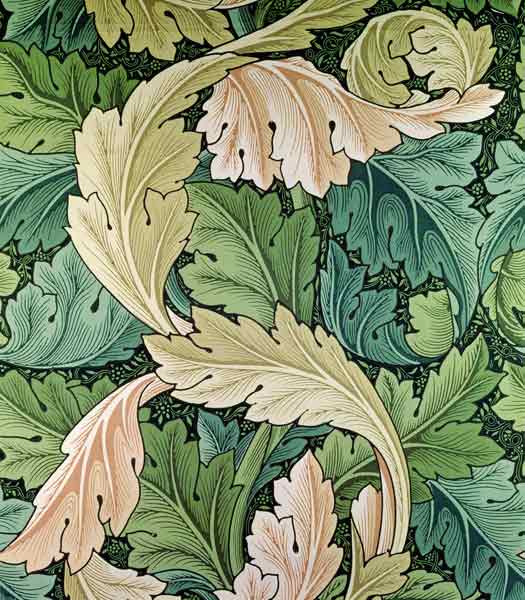
We will glimpse how Morris’ inner world and outer world curl, blend, and twist together like the acanthus leaves and willow boughs on his wall paper designs as art and craft become sacred acts in Part IV. Two specific examples that will be examined include Morris’ work at Merton Abbey—where a sacred collaboration with Nature surely took place—and Kelmscott Manor, Morris’ home and a place that today would be considered an integrated ecosystem. Additionally, in an effort to see how the tradition of social and climate focussed design of which Morris is a part continues today, we will learn in Part IV about contemporary arts, craft, and trade movements that are quickly bubbling up and consider Julie Watson’s Lo-Tek indigenous craft as climate resilience (Guadagnino, 2025).
Perhaps throughout this journey we will begin to understand that, for Morris, artistry and craftsmanship functioned as a type of prayer: a fusion of hand, heart, and Earth that rejected industrial capitalism’s defilement of nature (Ruskin, 1853) and private property’s habitūs dominativūs, the term Eckhart used for dominative consciousness, (Fox, 2020). If nothing else we might learn about a beautiful vision that was definitely ahead of its time, and which ultimately fell short, but did legitimately attempt in some ways to seek re-enchantment of the world by transforming wallpaper into biomorphic theology, workshops into eco-socialist sanctuaries, and labor into fellowship with nature (McCarraher, 2019).
…
BIBLIOGRAPHY
Arnot, R. P. (1964). William Morris: The man and the myth. Lawrence & Wishart.
Bevir, M. (2011). William Morris. In The Making of British Socialism (pp. 85–105). Princeton University Press. http://www.jstor.org/stable/j.ctt7s4ms.10
Bloch, E. (1968). Atheism in Christianity. Herder and Herder.
Calvin, J. (1845). Institutes of the Christian religion (H. Beveridge, Trans.). Christian Classics Ethereal Library. (Original work published 1536). https://www.ccel.org/ccel/calvin/institutes.html
Carrillo, S. (2024, April 22). More Gen Zers are turning to trade schools as college degrees lose their luster. NPR. https://www.npr.org/2024/04/22/1245858737/gen-z-trade-vocational-schools-jobs-college
Coyle, J. (2023, September 27). In Hollywood writers’ battle against AI, humans win (for now). AP News. https://apnews.com/article/hollywood-ai-strike-wga-artificial-intelligence-39ab72582c3a15f77510c9c30a45ffc8
Crawford, M. B. (2009). Shop class as soulcraft. Penguin.
Discovery UK. (2021, February 2). How To Make Illuminated Manuscripts Using Traditional Techniques | History In The Making. YouTube. https://www.youtube.com/watch?v=PF2nmSLjPG8&t=1s
Etsy. (2023). Annual Report: 7.5M active sellers, $13B+ merchandise sales.
Fox, M. (2014). Meister Eckhart: A mystic-warrior for our times. New World Library.
Fox, M. (2020, May 26). Meister Eckhart: Mystic critiquing unjust economic consciousness. Daily Meditations with Matthew Fox. https://dailymeditationswithmatthewfox.org/2020/05/26/meister-eckhart-mystic-critiquing-unjust-economic-consciousness/
Griffith, J. (2023, June 7). An Introduction to William Morris. YouTube. https://www.youtube.com/watch?v=ej3UzYMz4K8
Guadagnino, K. (2025, March 31). Julia Watson Champions Indigenous Coastal Design Strategies as models for Climate Resilience. Architectural Digest. https://www.architecturaldigest.com/story/julia-watson-champions-indigenous-coastal-design-strategies-as-models-for-climate-resilience
MacCarthy, F. (1994). William Morris: A life for our time. Faber & Faber.
Marx, K. (1939). Grundrisse. (Posthumous).
Marx, K., & Engels, F. (1976). The German ideology (3rd ed.). International Publishers. (Original work published 1846)
May, T. (2024, November 4). Design trends for 2025: Creative leaders share their vision for the future. Creative Boom. https://www.creativeboom.com/insight/what-emerging-trends-will-be-big-in-2025-we-asked-creative-leaders-for-their-predictions/#:~:text=6.,based%20on%20stored%20user%20preferences.%22
McCarraher, E. (n.d.). Chapter 3: The Poetry of the Past. In The Enchantments of Mammon (pp. 90–99). essay.
McGinn, B. (2001). The mystical thought of Meister Eckhart. Crossroad.
Messinger, D. (2017). Beauty, nature, and Laudato Si: Locating John Ruskin’s naturalism within the framework of theological aesthetics. Say Something Theological: The Student Journal of Theological Studies, 1(1), Article 4. https://digitalcommons.lmu.edu/saysomethingtheological/vol1/iss1/4
Morris, W. (1887). The aims of art. https://www.marxists.org/archive/morris/works/1886/aims.htm
Morris, W. (1890). News from nowhere. Reeves & Turner. (Original work published 1890)
Morris, W. (1910–1915). The collected works of William Morris (Vols. 1–24). Longmans, Green & Co.
Morris, W. (1950). The letters of William Morris to his family and friends (P. Henderson, Ed.). Longmans.
Morris, W. (2021). The hopes and fears for art: III. The beauty of life. Marxists Internet Archive. (Original work published 1882). https://www.marxists.org/archive/morris/works/1882/hopes/chapters/chapter3.htm
Ruskin, J. (1853). The nature of Gothic.
Ruskin, J. (1853). The Stones of Venice (Vol. 2). Smith, Elder & Co.
Tapper, J., & Ahmed, A. (2024). The ‘boring phone’: stressed-out gen Z ditch smartphones for dumbphones. The Guardian. Retrieved 2025, from https://www.theguardian.com/society/2024/apr/27/the-boring-phone-stressed-out-gen-z-ditch-smartphones-for-dumbphones.
Thompson, E. P. (1977). William Morris: Romantic to revolutionary (2nd ed.). Merlin Press.
Weingarden, L. S. (1985). Aesthetics politicized: William Morris to the Bauhaus. JAE, 38 (3), 8–13.
Wikipedia. (n.d.). William Morris. Retrieved June 14, 2024, from https://en.wikipedia.org/wiki/William_Morris
Tags:architectureArts & Crafts Movementdesignecologyeconomicsindigenous thoughtJohn RuskinJulie WatsonmarxismMeister EckhartmysticismpantheismRomanticismsocialismtheologyWilliam Morris

0 Comments