
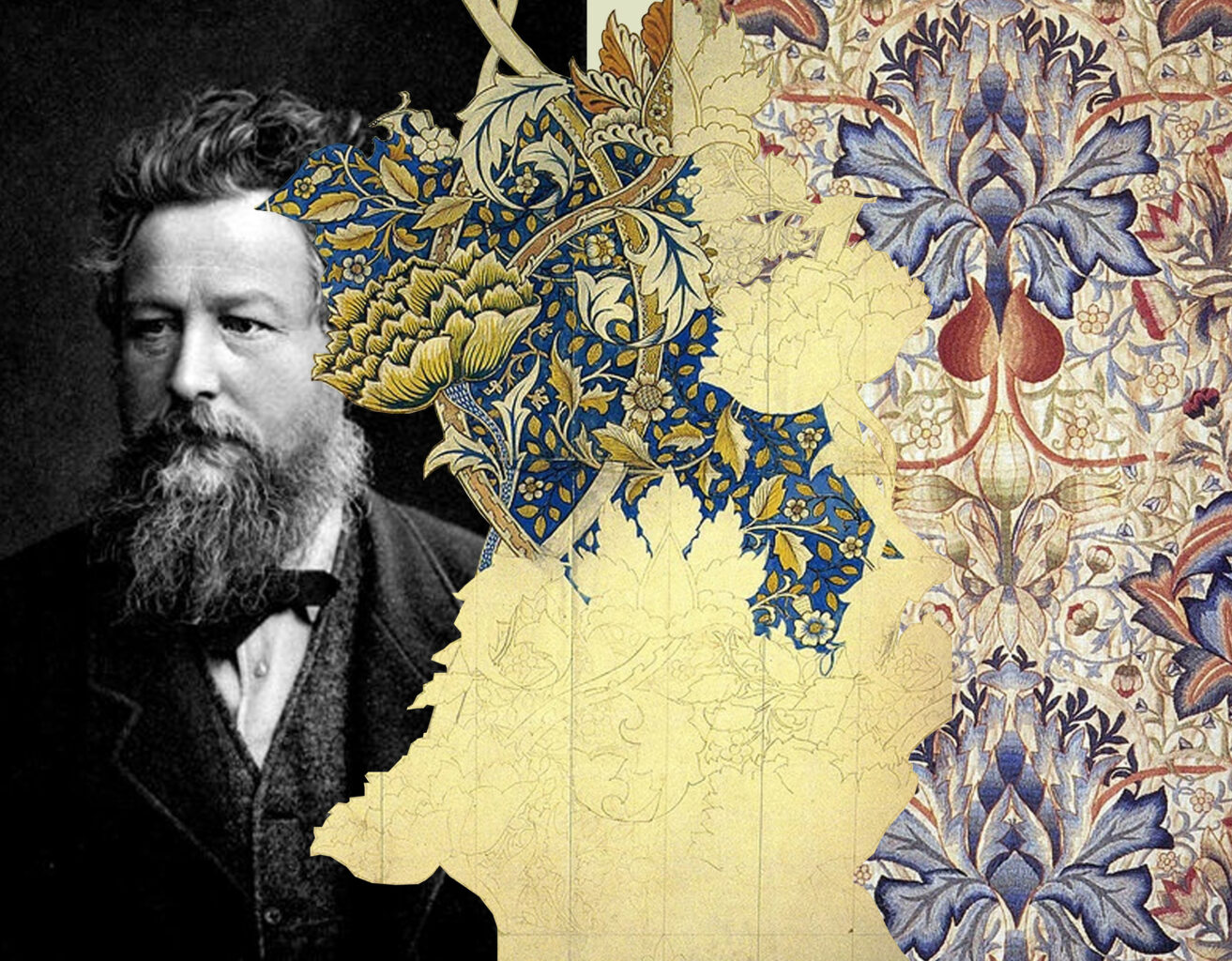
The Theo-Aesthetic World of William Morris
Recently, for a grad school class, we were asked to write an essay on a “design pioneer” of our choice for the first half of the summer session. For the second half, the class was asked to create a visual project based on the designer we had chosen. I chose British designer, writer, thinker, and social activist, William Morris, to write about and then magically turned the essay into a 52 page chapbook which I produced at home.
Part I: A Fusion of Hand, Heart, and Earth
As generative AI floods our screens with astonishingly strange deepfakes and algorithms continue to commodify creativity, a quiet rebellion has been blooming: Gen Z “Luddites” ditch smartphones for flip phones (Tapper & Ahmed, 2024), TikTok artisans stream meditative pottery and soul satisfying ASMR sessions while Hollywood strikers demand bans on AI scriptwriting (Coyle, 2023). These are not mere trends but acts of sincere resistance that echo William Morris’ 19th-century crusade against industrialism’s ‘soulless, mechanical’ production (Morris, 1887). Like today’s movements, Morris waged war on alienation by reclaiming labor as sacred art and craft. His rallying cry—”Have nothing in your houses that you do not know to be useful or believe to be beautiful” (Morris, 1882/2021, para. 4)—was both aesthetic manifesto and spiritual politics.
This essay will introduce the reader to the creative and theologically aesthetic world of William Morris: designer, poet, thinker, writer, and social activist famously associated with the British Arts and Crafts movement. We will begin by examining the Victorian world into which Morris was born, recognizing as he did the industrial blight and class stratification that accompanied the rapid scientific and industrial progress of the time. We will also pay close attention to the Puritan ethics and social norms that helped define the era and shape the famous designer.
In Part III we will turn to explicitly discuss Morris’ inner world of ideas to uncover a mystical lineage beginning with his medievalist awakening while studying at Oxford where we will find ourselves learning about the ‘divine ground’ written about by the 14th century German monk, Meister Eckart (Fox, 2014). This medievalist foundation will help us understand two of Morris’ other major intellectual, artistic, and social justice influences beginning with Karl Marx, and his concept of ‘artistic labor’ (Marx, 1939), along with John Ruskin and the idea of Nature as Sacred Text (Ruskin, J. 1853). All of this will culminate in Morris crafting ideas that suggest Guild labor can be understood as fellowship with nature and as a sacred act of prayer leading to something like theo-aesthtic pleasure and fulfilment.
We will glimpse how Morris’ inner world and outer world curl, blend, and twist together like the acanthus leaves and willow boughs on his wallpaper designs as art and craft become sacred acts in Part IV. Two specific examples that will be examined include Morris’ work at Merton Abbey workshop—where a sacred collaboration with nature surely took place—and Kelmscott Manor, Morris’ home and a place that today would be considered an integrated ecosystem. Additionally, we will uncover how the social and climate justice focused design of which Morris was a part continues today. We will learn in Part IV that contemporary arts, craft, and trade movements are quickly bubbling up and then turn to consider Julie Watson’s study of Lo-Tek indigenous craft as a way to anticipate, prepare for, respond to, and even recover from the impacts of climate change. (Guadagnino, 2025).
Perhaps throughout this journey we will begin to understand that, for Morris, artistry and craftsmanship functioned as a type of prayer: a fusion of hand, heart, and Earth that rejected industrial capitalism’s defilement of nature (Ruskin, 1853) and private property’s habitūs dominativūs (dominative consciousness), a Latin term that expresses Eckhart’s belief that certain things, if left unexamined, can truly dominate us and alienate us from each other and the from Divine (Fox, 2014). If nothing else we might learn about Morris’ beautiful vision that was definitely ahead of its time, and which ultimately fell short, but did legitimately attempt in some ways to seek re-enchantment of the world by transforming wallpaper into biomorphic theology, workshops into eco-socialist sanctuaries, and labor into fairly compensated fellowship with nature (McCarraher, 2019).
II Outer World: The Victorian Crucible
The England of William Morris’ birth (1834) was a world reshaped by the new tech of the day: steam and steel. Factories vomited coal smoke over cities like Manchester, where “the river ran purple with dye” and, in the worst conditions, life expectancy plummeted from 30–40 years of age to just 19 years for industrial workers (Thompson, 1977, p. 43). Children as young as five scavenged in textile mills, their small bodies crawling beneath mechanized looms to clear jammed threads—a practice Morris denounced as the “commodification of life itself” (Art and Socialism, 1884). In what was described as the “age of shoddy” by historian E.P. Thompson, nature was reduced to raw material, workers to mere “hands,” and beauty to ornament masking exploitation:
“The world was becoming one great prison-house of brick, where the air was poison and the sunshine a myth.” (Thompson, 1977, p. 112)
Morris’ childhood, despite being born to wealthy parents and housebound in Walthamstow, Essex with his mother, Emma, unfolded under a similar shadow: that of Calvinist theism in the form of evangelical Anglicanism—a worldview that framed God as a distant sovereign demanding relentless productivity. This upbringing in “rich establishment Puritanism” (Morris, 1950, p. 184) imposed a rigid duality on Morris where labor was understood as either sacred discipline or sinful idleness. This type of supernatural and legalistic theology was crafted by none other than the former lawyer, John Calvin, and it often depicted God as a celestial judge surveilling human toil (MacCarthy, 1994). A highly influential Calvinist preacher of the day, Charles Spurgeon (1857/2024), epitomized the twisted Puritan misinterpretation of Proverbs 16:27 by saying in a sermon:
“The most likely man to go to hell is the man who has nothing to do on earth. Idle people tempt the devil to tempt them.”
Morris’ father, William Morris Sr., was a financier and business person in London who certainly embodied the Protestant work ethic. Morris would later rebel against this awfully simplistic framing of the work ethic, seeming to intuitively sense the imminent danger of its complicity in industrial capitalism. As is often the case with beautiful theology and dandelions, however, they find ways to shine through cracks in sidewalks. In letters to his sister Henrietta, he recalled childhood prayers that described labor as sacred stewardship:
“We were taught that idleness was sin, but so too was work without joy—for God delights in creation, not drudgery.” (Morris, 1950, p. 67)
This tension—between Puritan discipline and the joy of making—would ignite Morris’ lifelong quest to redeem labor from industrial degradation.
From 1853—1855 Morris attended Oxford where he seemingly discovered an antidote to Victorian squalor: medievalism. With fellow student, Edward Burne-Jones, he devoured Gothic architecture and Arthurian legends, seeing in cathedrals like Chartres an “ecological sanctuary” where craft, community, and nature entwined (MacCarthy, 1994, p. 73). This Medievalist vision materialized in 1859 at Red House—Morris’ collaborative architectural masterpiece with architect Philip Webb.

Fig 1: By Ethan Doyle White, CC BY-SA 3.0The Red House (Bexleyheath, London, 1859), designed by Philip Webb for William Morris with stained glass by Edward Burne-Jones. It rejected Victorian industrialism by reviving medieval principles: honest materials (exposed brick), handcrafted totality, and organic, asymmetrical forms. This Arts and Crafts manifesto embodied a holistic return to craftsmanship, integrating art into daily life through collaborative, guild-like creation. https://commons.wikimedia.org/w/index.php?curid=44442695
According to biographer Fiona MacCarthy, Red House was built as a family home and as an eco-artistic safe haven that exuded handcrafted harmony utilizing things like locally quarried brick, hand-forged ironwork, and orchards replacing formal gardens. The house was certainly the Morris family’s sacred space for a time containing a chapel-like central hall where sunlight streamed through stained glass onto hand-embroidered fabrics (MacCarthy, 1994).

Fig 2a: Front Hall of the Red House (1859), Bexleyheath, London. Designed by Philip Webb for William Morris. The rectangular hallway is furnished with a large wooden bench (Fig 2b) with illustrations by Morris depicting the medieval German epic Niebelungenlied, and the stained glass windows filled the space with beautiful light. The hall features exposed structural elements and Gothic trefoil motifs that were favored by Arts and Crafts practitioners. Note. Adapted from Smarthistory, n.d. (https://smarthistory.org/william-morris-and-philip-webb-red-house/).
This desire to seek beauty, collaboration, and harmony with nature is evident in Morris’ Red House, and perhaps one can begin to see that this Victorian crucible—industrial defilement, Puritan discipline and Gothic redemption—set the stage in many ways for Morris’ mystical synthesis. As we turn to directly explore Morris’ inner world of ideas, we will trace how art critic and philosopher, John Ruskin, economist, Karl Marx, and a medieval monk named, Meister Eckhart, blend together to bring about an eco-aesthetic synthesis.
III Inner World: The Mystical Lineage of William Morris
Meister Eckhart (1260–1328) was unique in his time, he took political stands on behalf of the peasants of Germany and also on behalf of a women’s movement in the Middle Ages, supporting a group called the Beguines. A radical Dominican theologian and mystic, Eckhart preached a groundbreaking theology centered on the immanent “Godhead” (the formless divine ground beyond personhood) and the soul’s union with the Divine—ideas later condemned as heretical by the Church. Eckhart preached to people in their common language about the ‘dangers of following the ideologies of those at the top of the political and economic hierarchy and about the importance’ of recognizing ‘[their] own “nobility”‘ (Fox, 2020, para. 3).
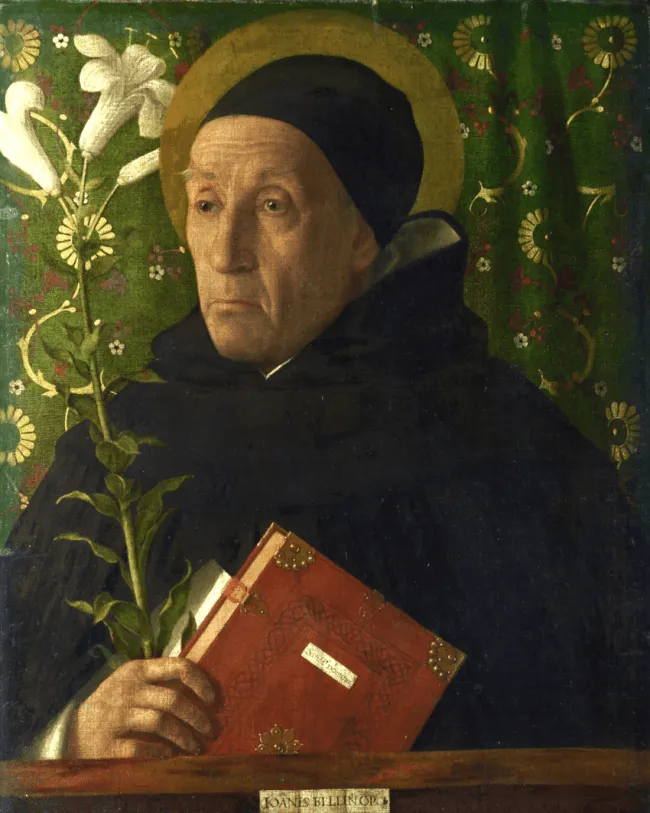
Fig. 3 Portrait of Meister Eckhart (c. 14th Century) Note. Historical depiction of the German theologian and mystic. From Mysticism and Heresy in Medieval Europe: The Cases of Meister Eckhart and Marguerite Porete [Online article], by HistoryMedieval.com, n.d. Copyright restrictions may apply. Retrieved June 20, 2025, from https://historymedieval.com/mysticism-and-heresy-in-medieval-europe-the-cases-of-meister-eckhart-and-marguerite-porete/
“Eckhart criticizes the “merchant mentality” for the consciousness it creates — an inability to receive, a reducing of things to objects for use, which creates, to use his word, “alienation.” We have serious work to do, God’s work, and this alienation and distraction and misplacement of consciousness seriously interferes with it.”
Although not being directly influenced by Eckhart’s thought this seems to deeply connect with Morris’ expressed hatred of industrial exploitation. More profoundly, Eckhart’s concept of the “ground” (grunt)—which is a pantheistic vision where “the soul’s depth and God’s depth are one” (McGinn, 2001, p. 110)—reframed labor as a type of theophany, a wonderful theological term that describes the tangible human experience of the presence and character of God. For Eckhart every act of creation participates in Divine immanence. For Morris, this would eventually take the shape of things like weaving or woodcarving becoming sacramental, something Eckart would most likely approve of and which can also be viewed posthumously as a noble attempt at dissolving Calvin’s theistically transcendent God-human divide.
Another thinker who was not friendly to the God-human divide was Karl Marx (1818–1883)—philosopher, economist, and Morris’ late-life mentor. Marx and Morris never met in person but Morris became deeply influenced by Marx’s writings in the 1880s after his increasing disillusionment with liberal reform. Unlike Morris, Marx was directly influenced by Eckhart’s theology and incorporated some of it into his materialist economics. In his book Grundrisse (1857/1939), Marx contrasted pre-capitalist craftsmanship with industrial alienation:
“…craft, artisan work; bound up with it, the guild-corporation system etc. […] Here labour itself still half artistic, half end-in-itself etc. Mastery.”
This “artistic labor” was considered part of the human species-being for Marx, and as the philosopher and Marx scholar, Ernst Bloch, has revealed, it seems to secularize Eckhart’s notion of divine co-creation (Bloch, 1968). Where Eckhart framed alienation as spiritual exile from divine ‘ground’ (grunt)—treating creation as property rather than sacred gift—Marx expanded this concept into four material dimensions:
- Alienation from the product of labor (commodification of the product; separate from the maker)
- Alienation from the act of production (breaking the product up into simple steps so the producer only does a simple part; no mastery just drudgery)
- Alienation from one’s species-being (humans are separated from their unique capacity for free, conscious, universal, and creative activity; exiled from their own creative essence)
- Alienation from other humans (social relations become mediated by capital).
For Marx, capitalism’s habitūs dominativūs was not merely abstract theopoetic theory but embedded in capitalism’s cycle of wage labor and private property, severing workers from nature’s rhythms (Marx & Engels, 1976). Morris witnessed this in Manchester’s mills—children choking on cotton dust, rivers poisoned by dye—confirming industrialization as both economic exploitation and cosmic desecration of Eckhart’s ‘divine ground’ (Thompson, 1977).
Morris’ writings began to fuse Marx’s analysis with mystical urgency. Socialist revolution, for Morris, meant restoring fellowship with Nature (Morris, 1890)—not merely redistributing wealth but returning labor to its sacred status. As he declared in his book News from Nowhere: “The reward of labour is [a beautiful] life. Is that not enough?” (Morris, 1890, p. 52). This was, perhaps, Morris’ way of transforming Marx’s class struggle into a type of eco-theological art practice with humanity’s place in nature’s liturgy being primary.
Enter art critic and social reformer John Ruskin (1819–1900)—Morris’ revered “master,” who pioneered a vision where art, ecology, and ethics converged. Ruskin’s seminal work The Stones of Venice (1853)—illustrated and published by Morris—especially the chapter The Nature of Gothic, became Morris’ spiritual compass. Ruskin argued that Gothic architecture’s imperfections (asymmetry, tool marks, etc.) were not flaws but theological virtues that honored nature’s wild autonomy and revealed the artisan’s sacred humanity. As Ruskin declared:
“We want one man to be always thinking, and another to be always working; it is the division of souls into men of intellect and men of drudgery that defiles both labor and nature.” (Ruskin, 1853, p. 10)
Ruskin was a naturalist and explicitly condemned industrialism as a spiritual and ecological violation, declaring it a “defilement of nature” (Ruskin, 1853). He saw factories and pollution as desecrating Divine creation, reducing workers to soulless cogs while endangering natural beauty. This critique resonated with Morris’ first hand witness of industrial blight solidifying Ruskin’s view that mechanization severed humanity from sacred reciprocity with the Earth.
Morris integrated Ruskin’s sacramental ecology into his ecologically aesthetic socialism and embraced the idea of nature as a “sacred text,” where it was believed that guild labor might restore a type of fellowship with nature. Morris poetically puts it this way:
“Go back again, now you have seen us, and your outward eyes have learned that in spite of all the infallible maxims of your day there is yet a time of rest in store for the world, when mastery has changed into fellowship – but not before” (Morris, 1890, Ch. XV).
For Morris, Ruskin’s vision transformed craftsmanship and artistry into prayer—a fusion of joy, stewardship, and resistance against what both deemed the dominative consciousness (habitūs dominativūs) of industrial capitalism (Fox, 2014; Ruskin, 1853).
IV Design Praxis & Legacy
Merton Abbey Workshops
Founded in 1881, Morris’s Merton Abbey Workshops were strategically planned as an anti-industrial sanctuary. Rejecting urban factories, Morris selected a 7-acre rural site along the River Wandle in Surrey for its clean water—essential for natural dyeing—and for it’s proximity to London for distribution (MacCarthy, 1994). The layout of his workshops integrated guild training practices with ecological stewardship:
- Regenerative Material Sourcing: Dye gardens cultivated organic pigments like indigofera tinctoria (blue) and rubia tinctorum (madder root for reds), with compost systems recycling plant waste into fertilizer (Arnott, 1964).
- River-Powered Production: Waterwheels harnessed the Wandle River’s current to operate looms, synchronizing labor with natural flow cycles to avoid “nature’s defilement by steam” (Morris, 1887, para. 9).
- Circular Workflows: Raw wool was cleaned in the river, hand-dyed using plant extracts, and woven onsite—eliminating synthetic chemicals and industrial intermediaries (Thompson, 1977).
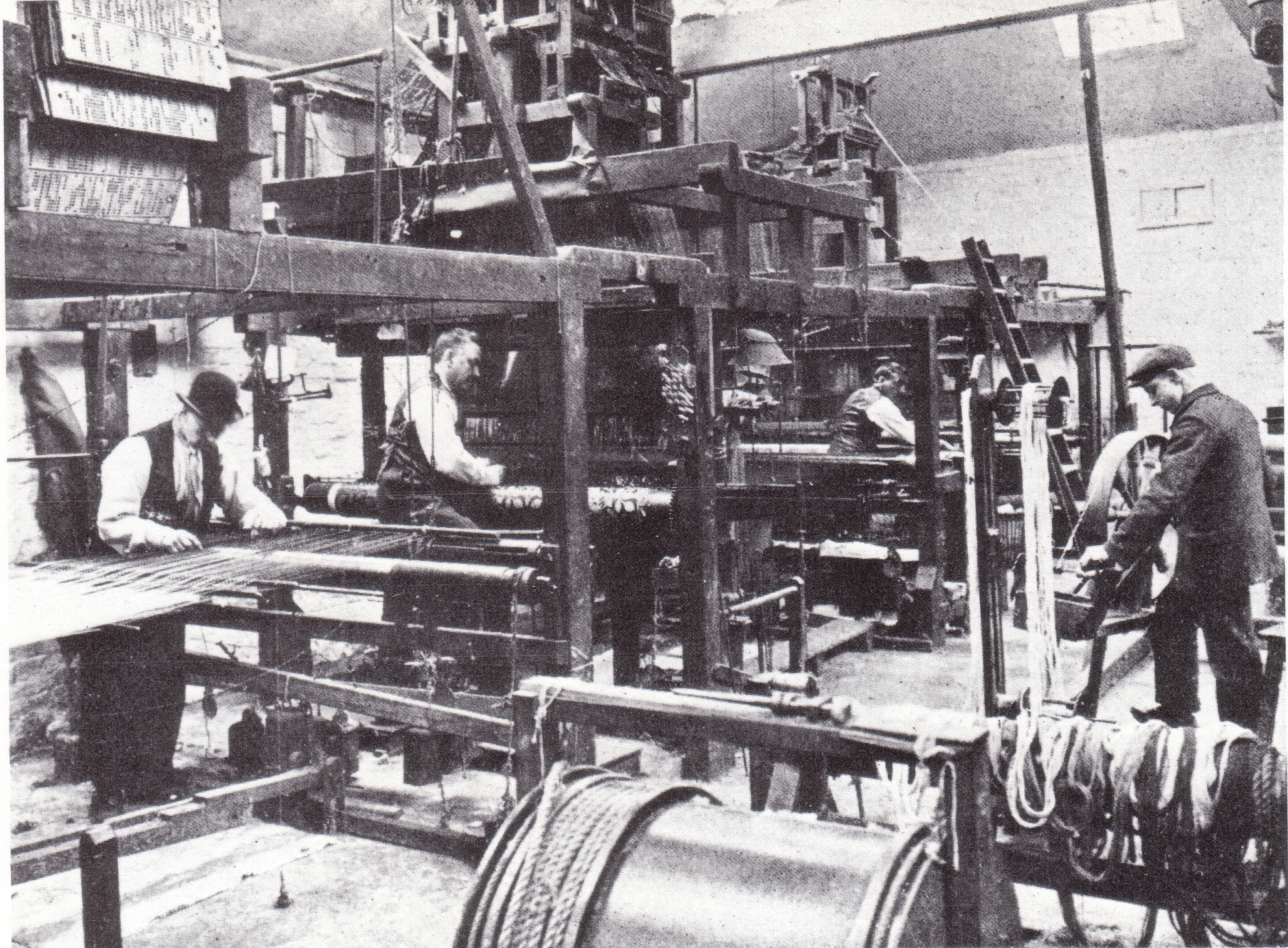
Fig. 4 Weaving at Morris & Company’s Merton Abbey Workshop Note. Photograph depicting workers at looms in the early 20th century with no child laborers, which was common at the time. From Morris and Company Weaving at Merton Abbey [Photograph], by Wikimedia Commons, 1907 (https://commons.wikimedia.org/wiki/File:Morris_and_Company_Weaving_at_Merton_Abbey.jpg). In the public domain.


Fig. 5 Acanthus Wallpaper (1875) by William Morris Note. Historic wallpaper design featuring densely interwoven acanthus leaves—a classical Mediterranean plant reimagined through Morris’s biomorphic theology. Its sinuous vines and rhythmic symmetry reject industrial rigidity, instead mirroring regenerative ecosystems where growth patterns repeat without mechanical uniformity. Hand-block printed at Merton Abbey using organic pigments, the design embodies Morris’s eco-socialist vision: labor as sacred reciprocity with nature. As Morris declared, such patterns transformed walls into “prayers for nature’s immanence” (1882/2021), where every twist in the foliage honored the wild autonomy Ruskin celebrated in Gothic imperfection. From Morris Acanthus Wallpaper 1875 [Image], by Wikimedia Commons, 2012. Public domain.https://commons.wikimedia.org/wiki/File:Morris_Acanthus_Wallpaper_1875.jpg
Fig. 6 Willow Bough Wallpaper (1887) by William Morris Note. Iconic design depicting gracefully arched willow branches and leaves, inspired by Thames-side flora near Kelmscott Manor. Its flowing, asymmetrical repetition—printed with madder root dyes on sustainable paper—rejects Victorian ornamentation by emulating nature’s “imperfect” organic symmetries. For Morris, this was craft as mystical praxis: artisans hand-carved blocks to channel what he called the “soul-satisfying joy” of co-creation (Morris, 1887), merging medieval guild ethics with Ruskin’s ecological sacramentalism. The pattern’s immersive rhythm visually enacted his belief that “fellowship with nature” begins when labor escapes commodification (Morris, 1890). From Willow Bough [Image], by The Metropolitan Museum of Art via Wikimedia Commons, 1887/2021. CC0 1.0. https://commons.wikimedia.org/wiki/File:Willow_Bough_MET_DP306734.jpg
Yet this utopian vision clashed with economic reality. Handcrafted production costs limited accessibility; as E.P. Thompson noted, Morris & Co.’s goods served “only the houses of the well-to-do,” forcing artisans into “wage-worker” status despite guild ideals (1977, p. 316). Morris conceded in his essay Art Under Plutocracy that his workshops “minister[ed] to the swinish luxury of the rich” (1915, p. 192), revealing a core tension between his socialist ethos and market constraints.
Kelmscott Manor
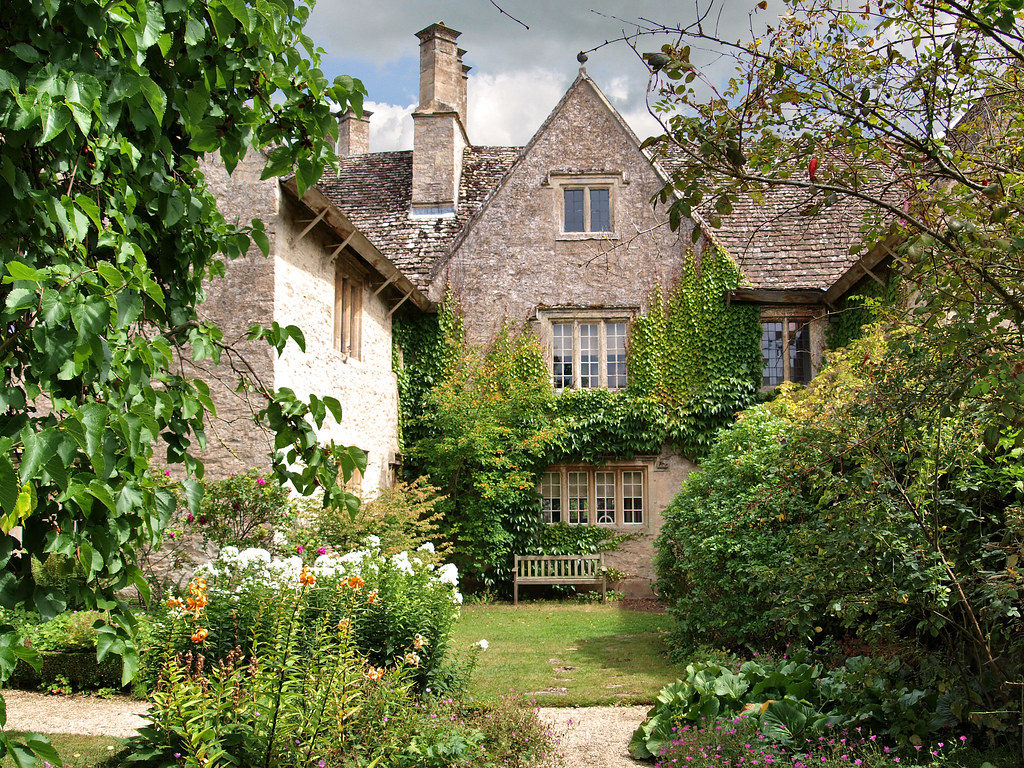
Fig 7 Exterior View of Kelmscott Manor Note. Tudor-era manor (c. 1570) built from vernacular Cotswold limestone—a material quarried locally and aged to harmonize with the Thames Valley landscape. Morris enhanced its ecological integrity: traditional oak beams support lime-plaster walls; handwoven Hammersmith carpets line floors; and medicinal herb gardens replace formal landscaping. This Gesamtkunstwerk (total artwork) integrated regenerative systems—wildflower meadows, rainwater harvesting, and hand-dyed fabrics—into a living ecosystem. For Morris, the Manor materialized his theo-aesthetic ideal: architecture as “fellowship with nature,” where every stone, stitch, and seedling affirmed labor’s sacred reciprocity (MacCarthy, 1994, p. 412). From KelmscottManor1.JPG [Photograph], by Elliott Brown, 2011, Wikimedia Commons. CC BY 2.0. (https://commons.wikimedia.org/wiki/File:KelmscottManor1.JPG). Licensed under CC BY-SA 2.0.)

Contemporary Interconnected Movements: Climate, Arts, Crafts & Trades
The ecologically aesthetic vision put forth by William Morris was not the first one and it was never alone. The mystical impulse to seek knowledge of the Divine in nature pre-dates the medieval pantheistic theology of Eckhart briefly discussed here, and of course Eckhart’s thought also has its roots. To Morris’ credit, however, most would put him in the proud lineage of designers who are associated with social and climate justice, and one of the contemporary designers most urgently working in this area today is Julia Watson. Using local and traditional ecological knowledge (Lo-TEK), Watson’s movement—which elevates Indigenous craft as climate-action praxis (not unlike what Morris was doing with ‘art and craft as sacramental prayer’)—documents techniques like Peru’s waru waru (raised-field agriculture) and Myanmar’s floating gardens as “models for climate resilience” (Guadagnino, 2025).

Fig 8 Woven Flood-Resistant Architecture. Note. This Indigenous structure employs totora reeds (Schoenoplectus californicus) woven into buoyant lattice walls, whose silica-fortified stems naturally resist water decay while capillary-sealed weaving limits saturation. Its hydrodynamic design elevates platforms 1.2–1.8 meters above floodlines, using curvilinear foundations to redirect currents and permeable walls to dissipate hydraulic force. Deep-rooted reed beds anchor the base as bio-swales, absorbing 300% their weight in water while integrated aquaculture creates regenerative fluid commons—echoing Morris’s ethos of craft as ecological reciprocity. Hand-harvested materials and communal construction transform vulnerability into resilience, secularizing Eckhart’s “divine ground” into climate praxis (Guadagnino, 2025) and fulfilling Morris’s vision of labor honoring “nature’s wild autonomy” (Ruskin, 1853). From “Julia Watson Champions Indigenous Coastal Design Strategies as Models for Climate Resilience,” by M. Luckel, 2022, Architectural Digest. (https://www.architecturaldigest.com/story/julia-watson-champions-indigenous-coastal-design-strategies-as-models-for-climate-resilience). Copyright 2022
Simultaneously, in what can certainly be viewed as a related attempt to recapture the fusion of hand, heart, and Earth that Morris also sought in his time, Gen Z seems to be ditching pricey four-year college for trade schools (Carrillo, 2024), perhaps validating Matthew Crawford’s notion that manual work restores agency against algorithmic alienation (Crawford, 2009). Aside from this, the mere existence of Etsy’s 7.5 million artisans and crafters (Etsy, 2023) can be interpreted as the desire for a democratized handcrafted economy. It is quite possible that, if one squints, this bubbling up of digital artisanry, agro-ecology, and trade education can be seen as small manifestations of Morris’s belief that “useful work [is] pleasure in life” (Morris, 1890, Ch. XV), suggesting that art and craft could be what Ernst Bloch called “secularized prayer” (1968, p. 44) in an overheated world.
Conclusion
From Victorian industrial factory prisons of brick to the divine ground of Eckhart’s mysticism, we have seen how Morris’s outer and inner worlds entwined organically. Puritan rigidity and Ruskin’s sacramental ecology fuse together effortlessly with Marx’s ‘artistic guild labour’ and Eckhart’s anti-dominative ethos to create a praxis where art and craft become prayer—a sacred collaboration with Nature (MacCarthy, 1994). Though his workshops ultimately catered to the wealthy, Morris’s vision of craft as “secularized prayer” (Bloch, 1968) endures as a radical blueprint for reuniting hand, heart, and Earth in an age of algorithmic alienation. Today, this lineage of demonstrating climate resilience thrives in places like those documented by Julia Watson in her Lo-TEK book (Watson, 2020) proving that when labor is fellowship, not exploitation, we might reclaim Eckhart’s truth that ‘all people are noble mystics’ with Morris insisting that they are artists too.
0 Comments