
Erosion of Process Directly Erodes Comprehension: Reflections on AI, Skeuomorphism, and the Creative Process
“Be “dialectical” just for one minute: imagine a world where there is no point in teaching people things, the process of education is replaced by The Answer (no shade to Allen Iverson). You just… ask for the answers without regard to the process of making answers. Come on. Aren’t you imagining… Hell? Do we just want “the answer?” Is the process of learning how to find the “answer” meaningless? If you are in business or marketing, isn’t the point to simply get more eyes on the product? Make a little more money? What’s the point of thinking about how to do anything else?” –Bo Eberle
Reading Bo Eberle’s excellent post about AI recently has me thinking about AI and the creative process. Perhaps not surprisingly, I completely agree with Bo’s suggestion above that AI tools are obviously answer or product focused vs. process focussed. This (imo) raises the real danger of greatly reducing/minimizing and condensing the creative process (or practice). I’m sure this is what most of the enthusiastic folks in the business and tech world would say is precisely the point of these sorts of tools. AI tools are here to “stream line” creative production processes. However, as I’ve written before, those who know, know how much one’s process affects the quality of one’s work, and as Gregory Bateson reminds us, whether it’s AI generated or not art will remain form secreted from it.
One of the main features of AI tools is that they allow users to skip some parts of the creative/artistic/learning process, but this is not necessarily new. This was certainly the case for me when I went through design school in the early zinds (my preferred term for the 2000’s lol). The late 1990’s and early 2000’s were another time of technological transition, from analog to digital. This was when analog technologies like film photography, drawing with pencils/pens, painting with brushes and paints, and creating traditional paste-ups using phototypesetting techniques began being heavily replaced by digital computers. To my professors’ credit at PCT, however, regardless of how much I and the other unergrads wanted to jump on the iMac G4 and crack open Photoshop version 8 we were not permitted. This was because all design students were required (I use ‘were’ here intentionally because i do not know if it is this way any longer at PCT) to take analog art and design studio classes for their first year. No computers. This meant I spent a great deal of time photographing with film and developing that film in an actual dark room. I also did a lot of sketching and drawing with pens, pencils, light tables and other analog art tools. I remember taking a three-dimensional design class where we were asked to sculpt three dimensional forms out of styrofoam and sticks to create models; yeah the finished products may or may not have been cool looking, hard to remember actually, but the process itself sticks out in my memory as being quite enjoyable and extremely satisfying (especially slicing that styrofoam with a nice sharp blade! ((I have an ASMR post cooking don’t worry))). Forcing undergrad design students to study traditional art techniques was no doubt a way to encourage the importance of the creative process. Even back then in the early zinds professors knew how much computers condensed the creative process, and I think the fear then, as it is now, was an erosion of a comprehensive understanding.
One great example of this concern is found in Photoshop, the professional standard image editing software that’s been around since the 1980’s. Photoshop has a tool called the ‘Dodge/Burn’ tool and it is an example of ‘skeuomorphism,’ which is a design term that refers in this case to a digital interface that mimics its analog predecessor. To use it effectively, you need to understand the old darkroom techniques it’s based on: dodging to hold back light and lighten an area, burning to add more exposure and darken. The tool isn’t just a button for “make lighter/darker”; it serves as a conduit for a specific, physical process. For a generation that never developed film, this skeuomorphic design was a silent teacher. It forced the user to engage with the logic of the analog practice, not just the digital outcome. In a certain way the interface itself preserved a piece of the creative process that a purely abstracted “contrast slider” might have erased.
Sadly, our current AI tools are largely anti-skeuomorphic (on purpose I think). They present a blank prompt box—a pure abstraction. Like Bo points out in their piece, there is no embedded process, no history, no friction that teaches anyone anything. Users ask for an answer, and it generates a product, severing the lineage of how that product comes to be. Condensing the creative process risks creating a generation of people who have never dirtied their hands in the foundational clay of their craft and, consequently, their understandings will remain superficial. They may recognize the aesthetic form of a solution but remain blind to its underlying structure—the series of decisions, accidents, and constraints that give it integrity and meaning. Make no mistake, this erosion of process will directly erode comprehension.
…
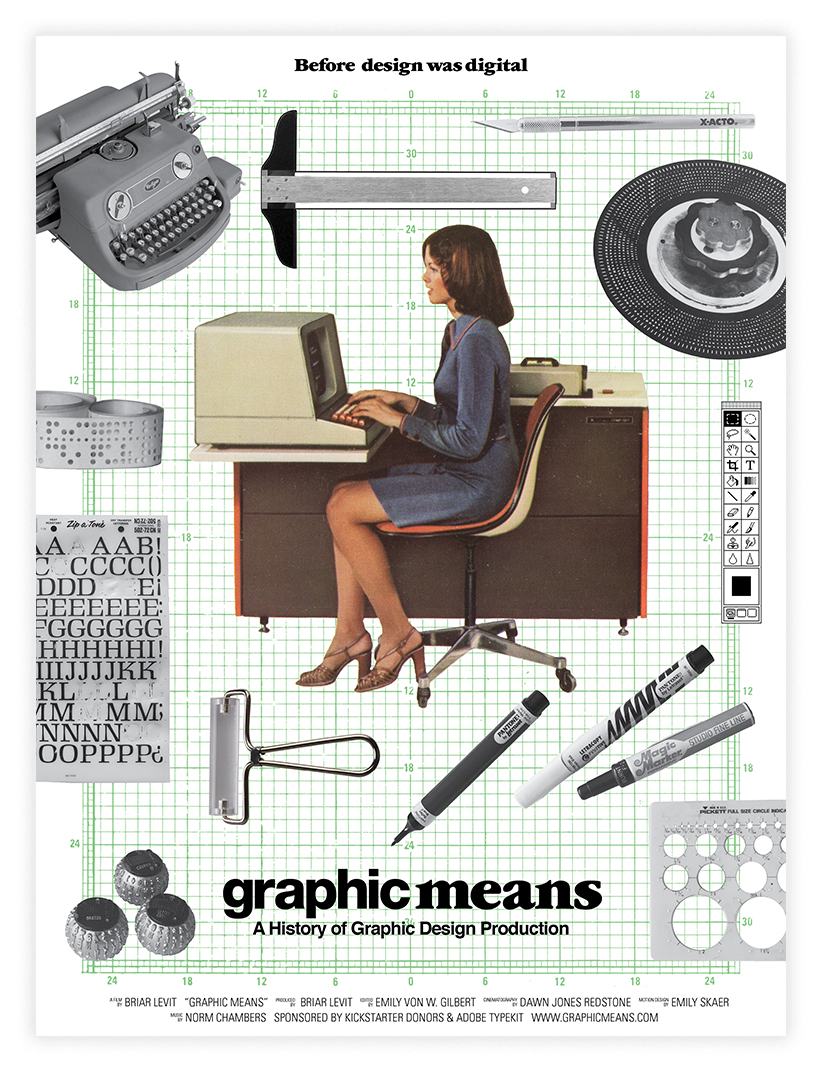
Poster above from the movie Graphic Means a documentary about the history of graphic design production.
0 Comments