
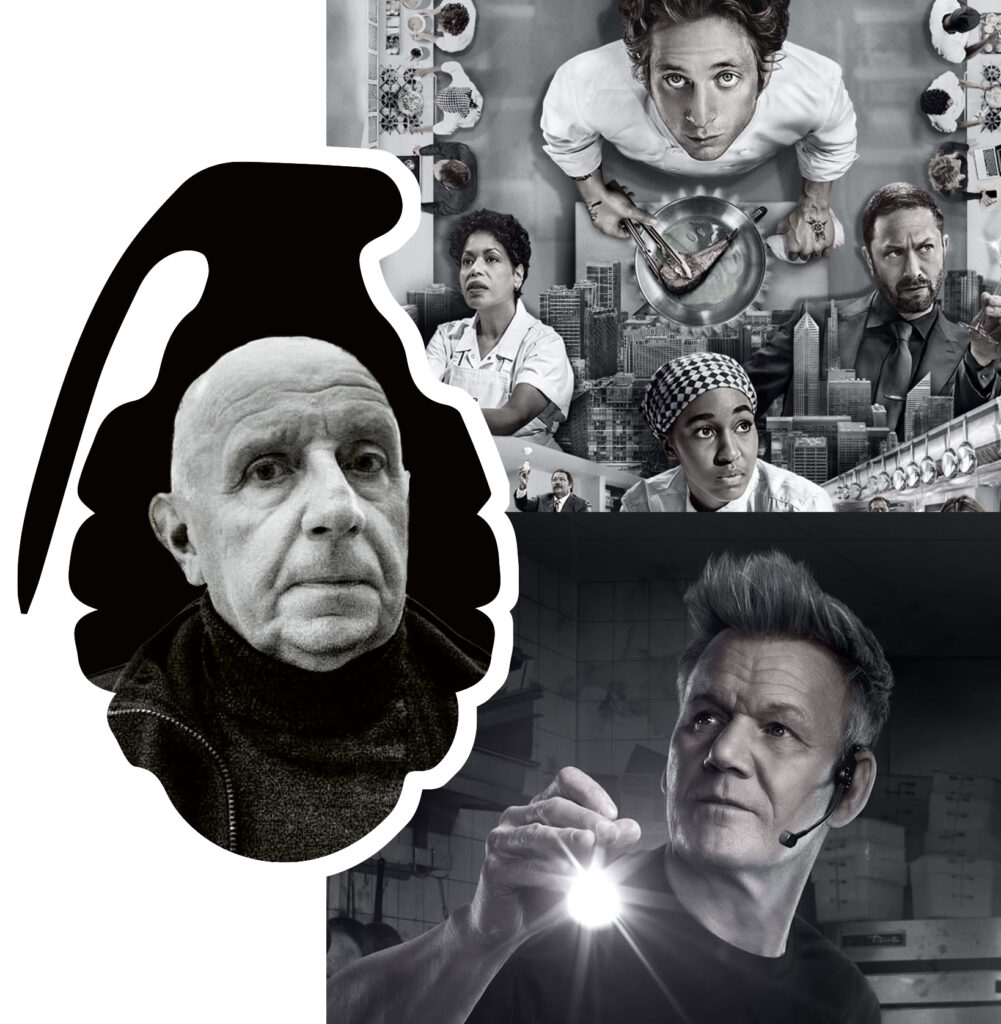
The Kitchen Bunker: Paul Virilio and the War Logic of Fine Dining
“All of us are already civilian soldiers, without knowing it… The great stroke of luck for the military class’s terrorism is that no one recognizes it. People don’t recognize the militarized part of their identity.” –Paul Virilio, Pure War. New York, NY, U.S.A.: Semiotext(e), 1983. p. 18
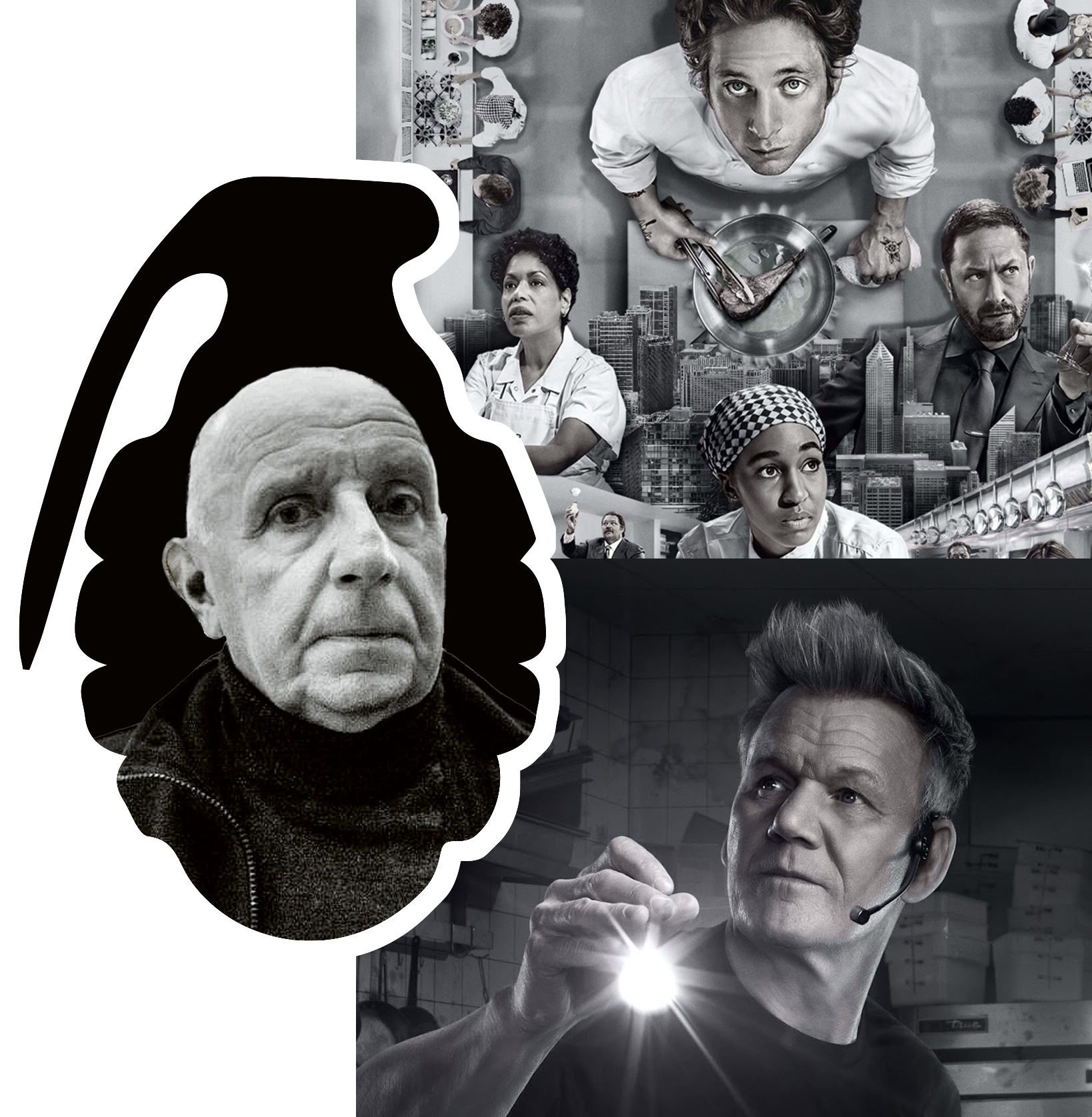
We normally don’t think about Paul Virilio while slicing onions, but we all should. The late French philosopher—whom I became interested in recently by listening to a wonderful episode of The Magnificast that was largely dedicated to his main ideas—was part urbanist, part war theorist, full-time prophet of speed, and a practitioner of nonviolent Christian anarchism (a topic often written about on this blog). From what I can gather, Virilio seems to have seen militarism in everything from church architecture to iPhones. And it hit me recently while watching two restaurant tv shows simultaneously with my spouse—season four of The Bear and Gordon Ramsay’s Secret Service—that nowhere does his “dromology” (Virilio’s term for ‘science of speed’) feel more violently immediate than in restaurant kitchens.
Born in Nazi-occupied France, Virilio spent his childhood sheltering in bunkers from Allied bombs and it’s hard to imagine that this firsthand exposure to militarized space and time did not became the bedrock of his philosophy. With this post I’d like to whip up a tasty little dish using some big Virilian ideas while keeping in mind as we go the kitchen brigade system. For those who don’t know, the kitchen brigade system is a hierarchical way to organize kitchen staff that was developed by Auguste Escoffier in the late 19th century and was inspired by his military experience during the Franco-Prussian War—this militarized method of organization is on full display in both The Bear and every Gordon Ramsay show ever made.
What follows is our ingredient list, which consists of a very inadequate explanation of a few key Virilian ideas and an example of how these ideas can be seen showing up in the two crazy-ass kitchen shows that I have recently ingested.
INGREDIENTS:
Dromology
“Dromology” (from Greek dromos, “race”) is Virilio’s science of speed. Virilio seems to have argued that speed isn’t just velocity; it’s the primary tool of control in modern society. So whoever moves fastest dominates territory, resources, and perception (and for those familiar with the show, “every second counts” is a mantra repeated endlessly in The Bear). Interesting, right? Even more-so when we learn that Virilio traced all technology back to warfare. The invention of trains, planes, and the internet wasn’t about progress for Virilio, it was about winning wars by outpacing enemies. An example Virilio witnessed as a child was the Nazi Blitzkrieg (“lightning war”) which used tanks and radios to collapse space through speed.
The Bear: In the opening episode of The Bear S4 a digital countdown clock is prominently placed in the kitchen, counting down from 1400 hours (equivalent to two months). This clock, set up by Uncle Jimmy and his accountant (a guy who’s nickname is “Computer” because he’s really good at emotionlessly crunching numbers to get to maximum profit) signifies the time the restaurant has to become profitable or face closure. A perfect first ingredient for our little recipe here.
Ramsay’s Secret Service: I would like to suggest that in the opening episode (S1E1) of this show, Ramsay’s signature midnight restaurant raid—filmed complete with night-vision cameras as he “investigates” a Greek restaurant rumored to have “gone downhill” over the years—exemplifies dromocratic terror. In every episode of this show Ramsay’s black light scans rotting food like battlefield reconnaissance, while hidden surveillance feeds accelerate judgment. The viewers witness staff being ambushed not just by filth (and trust me there is LOTS of filth), but by Ramsay’s speed: he demands things like menu overhauls and ownership transfers within 48 hours, weaponizing urgency to force submission. As Virilio observed, “speed is the form of war the ruling class wages”—here, similar to The Bear, Ramsay’s stopwatch replaces Escoffier’s brigade as the new command tool.
Pure War
As far as I can tell, Paul Virilio’s concept of “Pure War” seems to describe a state where society is perpetually organized for conflict, even during peacetime. It represents the transformation of war from physical battles into a continuous, invisible infrastructure shaping technology, economics, and daily life. Virilio declared that there is no true peace, only “Pure War.” Military logistics (supply chains, efficiency protocols) seep into civilian life, turning everything from factories to Apple stores into battlefields for economic dominance.
Perhaps the most succinct and easy way to get at this idea is to highlight the notion that unlike traditional types of war, like Simple War and Total War—which are conflicts with clear beginnings/endings—Pure War means endless preparation for destruction. Military logistics, technological innovation, and economic systems operate in a constant state of wartime readiness which ultimately ends up blurring peace and conflict.
The Bear: For those who have watched season 4 of The Bear it is no stretch to say that it frames the restaurant as a fortress of trauma. Carmy’s flashbacks to Mikey’s suicide during service isn’t just grief bubbling up, they can very easily be viewed as Virilio’s “peace as war by other means.” The kitchen’s hierarchy (Carmy as general, tickets as orders, etc.) perpetuates inherited violence. When Richie screams “SEVEN MINUTES!” during the ticket avalanche, he is essentially enacting logistical terror: compressing human labor into wartime efficiency. The staff’s panic attacks and silent suffering reveal Pure War’s chilling and core truth that restaurants (and let’s face it, many other workplaces) militarize bodies even without bullets.
Ramsay’s Secret Service: In S1E3 of this show Ramsay rescues Mrs. White’s Golden Rule Café in some ways. But in other ways this “rescue” epitomizes humanitarian Pure War. As usual, in this episode Ramsay deploys “shock therapy” with black light hygiene checks (most of these segments are sincerely revolting) simulating bunker raids—or in this show’s explicitly specific case, an Ethan Hunt Mission Impossible-style “covert operation.” Overnight renovations (blitzkrieg aesthetics), and emotional interrogation of owners are segments in every episode of this show. Yet like NATO’s “ethical bombs,” these superficial restaurant makeovers leave ownership hierarchies intact, the new equipment masking systemic violence. One could not be blamed for viewing Ramsay’s insider intel (also a feature of every episode) and surveillance van as operating like a dromocratic command center, reducing staff to civilian soldiers in a profit war.
The Accident
Virilio correctly observed that “When you invent the ship, you invent the shipwreck” and his “accident” theory (similar is some ways to McLuhan’s fourth law of media) argues that systems contain their own collapse. For Virilio the Accident is the inevitable shadow of progress: every technology carries its own inherent failure, like a shipwreck born with the ship itself. For Virilio, disasters—from nuclear meltdowns to algorithmic crashes—are not random flaws but revelations of a system’s hidden fragility. As innovations accelerate, accidents escalate from local tragedies to global “integral accidents” (e.g., climate collapse), where chain reactions defy control. Ultimately, these crises force a moral reckoning: they unmask the violence of speed-obsessed modernity and demand we build resilience over efficiency.
The Bear: Some readers may remember Carmy’s walk-in freezer panic attack in “Green” (S4E8). This panic attack appears to be an interruption in Carmy’s life, but it’s not; it’s the logical product of the brigade system’s militarized tempo. As tickets avalanche during the Tribune review crisis, the kitchen’s demand for hyper-speed (“SEVEN MINUTES!” Oh god, the shouting) converts time into a torture device. Carmy’s collapse manifests Virilio’s integral accident: his trauma fuses past (Mikey’s suicide), present (burning risotto), and future (Cicero’s countdown clock) into a single catastrophic rupture. The freezer—a stainless-steel bunker—becomes ground zero for the system’s self-destruction: efficiency cannibalizing the human. Crucially, the kitchen never stops during Carmy’s panic attack—proof that the accident isn’t a bug, but the system operating as designed.
Ramsay’s Secret Service: Ramsay’s show has no shortage of “accidents.” From expired fire extinguishers and uncleaned bone saws, to catfish left in cars (Parthenon episode), and as gross and inexcusable as these things are it’s also not hard to view them as staged “shipwrecks” used to justify authoritarian intervention. By spotlighting expired food and rodent infestations, Ramsay easily constructs a Virilian “accident” narrative: this restaurant is its own shipwreck. Yet these “failures” are carefully curated to justify Ramsay’s authoritarian intervention—a 48-hour blitzkrieg renovation that installs faster tech (sous-vide wands, POS systems) while ignoring systemic rot (owner Peter’s dementia, wage theft). Like NATO bombing Belgrade to “save” Kosovo, Ramsay’s rescue deploys moralized violence: the staged accident becomes pretext for reinforcing hierarchy. The real “shipwreck” isn’t the filth—it’s the show’s own premise, where salvation means submitting to Ramsay’s dromocratic way of doing things.
Chrono-Politics
Closely related to dromology is “Chrono-Politics,” Paul Virilio’s term for when time becomes the primary territory of control. Pre-industrial wars were fought over space (land, cities). Today’s wars are are about time: who controls attention spans, delivery algorithms, and transaction speeds. In this case survival depends on dominating minutes, not physical space. If you’ve ever worked in a kitchen then it’s not hard to imagine them being transformed into a temporal battlefield where efficiency is weaponized (Oh the stories I could tell of 15 year old me working in Burger King…). Once again, I refer to our two restaurant shows:
The Bear: If nothing else, season four of The Bear exposes the psychic cost of culinary speed. We see trauma after trauma arising in the televised Chicago kitchen, starting with the addition of the countdown clock already mentioned, but followed quickly by Carmie’s Groundhog Day binge in the same episode where we find him complaining about “feeling stuck in the same day.” Using Virilio we can see how speed’s pressure induces psychological freezing, “polar inertia” is the term Virilio might use. Carmy’s inability to innovate after the Tribune review (“Culinary Dissonance”) shows how acceleration traps individuals in cycles of self-doubt, stifling any sort of progress.
Ramsay’s Secret Service: Gordon Ramsay’s surveillance van transforms time into a torture device. In the episode featuring Callahan’s Seafood Bar in Maryland, he shamelessly monitors real-time kitchen feeds, screaming critiques of “slow” sauce prep through earpieces worn by staff. In my opinion this isn’t coaching—it’s chrono-colonialism: seizing control of seconds to dominate territory. Ramsay’s 48-hour renovation deadlines weaponize tempo, forcing exhausted cooks into “just-in-time” production lines. As Virilio warned, “whoever controls time rules the world”—Ramsay’s stopwatch is the new sovereign on this show.
To be fair, explicitly hierarchical restaurants are not unique; they’re simply the rawest and one of the most conspicuous examples of how militarism saturates labor and our lives. Virilio’s vision here helps reveal commercial kitchens as microcosms of a broader dromocratic hellscape: the countdown clocks, brigade hierarchies, and speed-terror tactics in The Bear and the Ramsay show mirror the chrono-colonialism invading every workplace. From Amazon warehouses policing seconds-per-package to call centers monitoring bathroom breaks, according to Virilio we’re all forced into Pure War—unwitting “civilian soldiers” serving mammon under the guise of efficiency.
Yet resistance flickers when workers reclaim time. For example, throughout season 4 of The Bear we witness Tina’s quest to master pasta timing. Again and again she experiments with prepping, portioning, and speeding up processes but repeatedly fails to hit the mark, causing her and those around her significant stress. It’s not until Luca’s intervention in episode 8 that some sound philosophical guidance is offered: “Perhaps it’s not meant to be done so swiftly. And that’s alright.” This advice shifts Tina’s focus from pure speed to mindful execution that effectively sabotages speed’s sovereignty. It’s possible that restaurants can teach us that disarming this war begins when we recognize the bunker in the breakroom, the general in the manager, and the radical love in a meal prepared with thoughtful, benevolent intention and then shared slowly. After all, solidarity isn’t just passed—it’s cooked. AMEN to that, Chef!
[…] To the astute reader the faith that is being reaffirmed in hunting rituals like these might be making itself evident at this point, and we’ll get back to this question of faith and passing down beliefs soon. But for now perhaps we can all agree that whatever else hunting is (and it is indeed many things) it is definitely an activity that has changed over time (like most things), and one of the most noticeable changes in hunting can be found in the technology used to kill all of those hunted, unarmed non-human animals. I’m referring explicitly to firearms. After the invention of the matchlock mechanism in the 1400’s, which made firing more controlled and allowed nobles and elites in Europe to begin using arquebuses to hunt large game, gun technology has continued to develop at a terrorizing, war-filled, dromologic pace. […]