
The Judgement and Salvation of the Lone Star Tick: Mammals, Meat, and Non-Human Prophets
“The central theme in the prophecy of Joel, one of the 12 minor prophets (dōdekaprophēton), is that the Day of the Lord (yōm ădȏnay) is at hand (chs. 2–3). […] Joel utilizes the concept contextually for his contemporaries, using the locust swarms to point to the Day of the Lord as a day of both judgment and salvation.“ –Michael Ufok Udoekpo, Religions Journal Vol.14 Issue 10
“Becoming sensitive to the ongoing process of sacred revelation requires us to actively reattune, reclaiming our capacity for careful and empathetic listening. Conceiving of communication and kinship across species lines, moreover, triggers an obligation of care.” –Ariel Evan Mayse, DIBUR Literary Journal, 16-17 Spring 2024 – Fall 2024
“Sallie McFague and other theologians argue that White failed to let the Yahwist dominion account of creation quarrel with the priestly version. In Genesis 2:15, God took “man” and put him in the Garden of Eden to fill and keep it, not to dominate it. […] Many think that ecology is all about nature when it is rather about peace. The metaphorical wolves and lambs of society have long fought over the water and the oil. The animals choose another way in the prophecy of just how different things are going to be. When tend and befriend replace dominion, wild and crazy things result.” –Donna Schaper, The National Catholic Reporter
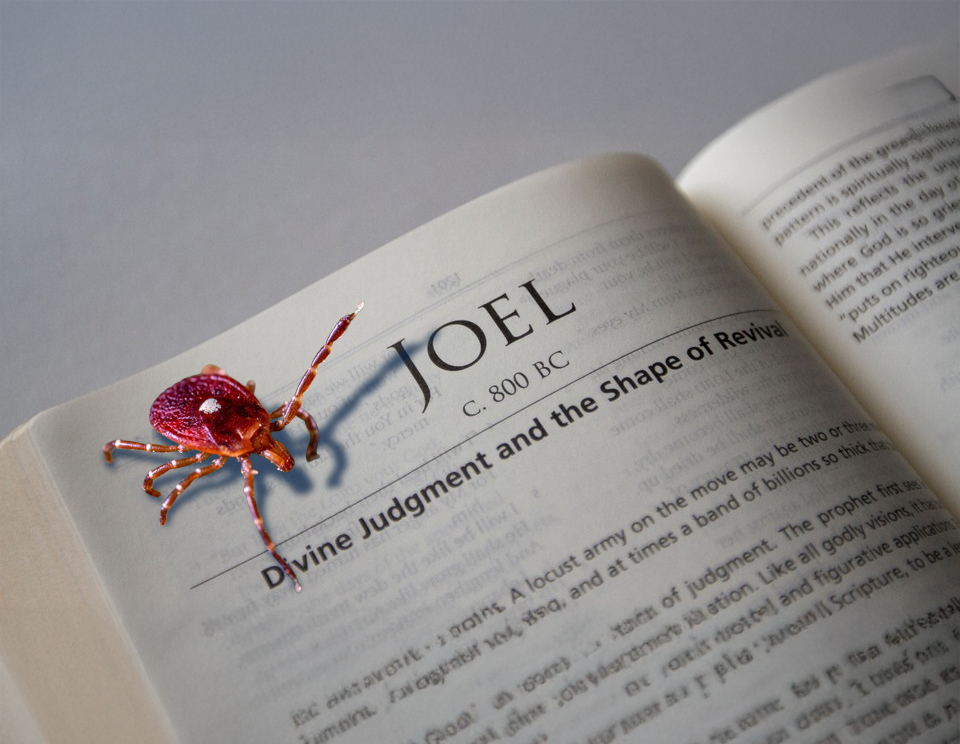
I’ve been reading some excellent contemporary work in ecology and eco-theology in an effort to make sense of some recent observations surrounding the weirdly simultaneous advent of two things: 1) the new food industry approved health guidelines issued by US Health and Human Services secretary, Robert F. Kennedy Jr, which calls for Americans to not eat less meat and diary but to instead gorge themselves on these products and 2) the prophetic rise of the Lone Star Tick. If you haven’t heard of the Lone Star Tick you might want to pay attention because a bite from one of these little guys can cause alpha-gal syndrome, which is a type of allergy “characterized by a delayed onset of symptoms (2–6 hours) after ingesting mammalian meat.[2]“
To compulsively get this bit out of the way first, recall what ecofeminist, Carol Adams, has taught us about the pernicious connection between meat and masculine identity (honestly, I think many men out there may be genuinely afraid that if they stop eating meat they’ll become too feminine ((and un-american of course))), how the production of meat inclines entire societies to accept the brutality of war, and how meat can be a symbol and instrument of patriarchy that elevates the status of men while denigrating the status of women and non-human animals, and then perhaps the hilariously serious irony of all of this will not be lost. After all, even though they’re mainly being found in the Eastern U.S. and Mexico the tick is called ‘Lone Star‘ which is the nickname of Texas, the largest beef producing state in the country as well as the state with the most registered guns (something I’ve noticed manly men also seem to enjoy), and of course the syndrome is called ‘alpha-gal‘ which (and maybe I’m stretching a bit here) can be connected to one of the favorite terms of tough-guy’s everywhere, ‘alpha male,’ substituting ‘gal’ for ‘male’ of course which actually makes it fitting for an allergy that prevents men from eating their favorite masculine food, effectively turning us all into beautiful alpha gals (#WinkEmoji).
On a more serious note, however, I do appreciate Udoekpo’s piece quoted above quite a bit and I think it is directly applicable here. Udoekpo’s essay explores Joel 1:2–7 using a African Biblical Hermeneutic and attempts to decolonize the interpretation of Joel’s locust plague, commonly interpreted by Euro-American scholars as an allegory for invading armies or a historical event viewed through a non-African lens. Instead Udoekpo highlights a dual African perspective—rooted in lived experiences and cultural contexts—on locusts as being both a type of devastation, by destroying crops and causing hunger, but also a type of provision that can sustain life as a type of nourishment for humans and livestock alike. The theological meaning Udoekpo urges the reader to walk away with is that this type of duality mirrors the prophecy’s message found in Joel. The plague represents God’s judgment on corruption and social injustice, particularly by selfish elites. Conversely, God’s promise of restoration (Joel 2:25) and blessing (3:18) reflects Their mercy and provision, offering hope amid hardship. To apply this to our current case we might say that the Lone Star Tick serves a similar purpose to the locusts found in Joel; they are a mirror offering us a glimpse at the global horrific (and for our purposes in this post: mammalian) suffering and environmental destruction we’ve wrought, but if we listen close they may also be offering us a path forward.
Now although many may not feel the same, I do see real hope here. Ariel Evan Mayse, in their essay quoted above, discusses the idea of “intraspecies skill-building,” which we can think of as instances of creatures teaching behaviors or modes of expression to one another and, if viewed openly and positively, this might be humanity’s chance to learn from our little friends and take them up on their obvious suggestion to give up meat, starting immediately with mammals (it’s worth pointing out here that process philosopher, Adrian Ivakhiv, made a case for a non-mammalion food ethic back in the teens which, again, is now also being highly recommended by the Lone Star Tick). Like the fantastic theologians they cite along the way (e.g. Catherine Keller and Mary Jane Rubenstein), I too affirm Mayse’s framing of divine revelation as an ongoing process within all creation, not confined to the historical event at Mount Sinai. Additionally, I agree that recognizing non-human animals as kin and teachers creates a moral obligation that requires humility, careful observation, and an expanded scope of concern.
Like giving up any addiction, however, quitting meat is not easy; it is difficult and requires courage, serious mental focus, lots of grace, planning, and discipline. It’s also beautifully life changing for you and for the non-human animals you’re not eating. For me, a commitment to nonviolence eventually led me to a plant-based diet but it also coincidentally (or not so coincidentally, some may say) contributed positively to the control and virtual elimination of an auto-immune disease of which I had struggled with for a while. The personal impact resulting from the combined spiritual (and let’s face it, political) disciplines of keeping a plant-based diet and practicing a type of sincere active nonviolence is concrete experiential proof of the healing and ecological peace that is possible, important subjects that Donna Schaper writes about in her piece at The Catholic Reporter. “Earthlings,” Schaper begins, “will be saved by our animal curiosity about each other. Whenever we imagine we are better than animals, we are choosing against them and their miracle ways. We are refusing to imagine peace. […] Peace comes when we move beyond one of our natures, that of fight and flight, into another of our natures, that of tend and befriend. Peace comes when we move out of one of the stories we tell ourselves — that we are here to have dominion — and move into another story: that we are here to fill and keep, tend and befriend the earth. Lions and lambs are meant for each other. We actually belong one animal to another.” May it be so.
0 Comments