
The Manliest of All Rituals: Critical and Creative Nonviolent Reflections on Hunting
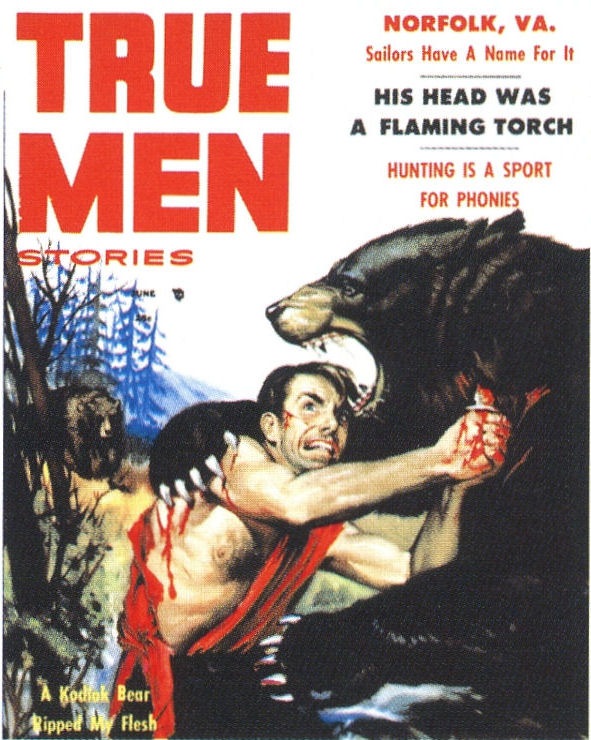
Art above found here. A quote from the article: “Man vs. beast was a common theme in the stories and art in men’s adventure magazines of the 1950s, 1960s and early 1970s. And, the bigger the beast, the better when it came to the perceived manliness of fighting or killing them.”
“The adoption of fixed settlements also created problems with regard to the status of women. When a hunter-gatherer people took up fixed settlement, in actual practice it pursued its livelihood through fishing or simple cultivation and herding, but it preserved the lifestyle that had existed in the hunter-gatherer phase. In sum, a division of labor persisted in which men engaged in hunting and women carried out foraging. But in reality the men’s hunting became largely a ritual activity. With the adoption of sedentary settlement, the necessary production was increasingly carried out by women. Yet it is important to note that this change led not to an elevation but to a lowering in the status of women. The males, who produced nothing directly but only engaged in symbolic production or supervision, stood in the superior position.” Kojin Karatani, The Structure of World History, Duke University Press, pg. 44
I’ve been enjoying Kojin Karatani’s excellent book, The Structure of World History—which I picked up recently after learning about it through Tripp Fuller’s and Guillermo Bervejillo’s wonderful conversation—and the above passage, which describes hunting as being largely a ritualistic activity for humans in “fixed settlements,” REALLY jumped out at me. What follows is a critical but creative reflection on hunting and how it can be redeemed.
This year my commonwealth of Pennsylvania has repealed a law that banned hunting on what many used to consider a very holy day. That’s right, 13 Sundays will be open for hunting in my neck of the woods this year according to the PA Game Commission. Considering this news, as I simultaneously reflected on Karatani’s notion of hunting being a religious ritual, it occurred to me that hunting today—as it is practiced in my U.S. context—is still largely a very unexamined religious ritual engaged in not exclusively but mostly by men who definitely live in fixed settlements (as opposed to being nomadic). And if there is one thing we all know about religious rituals, one of the basic functions/purposes of them is (among other things) to reaffirm faith and belief. But some may ask: what faith or belief is being reaffirmed and instilled in the ritual of hunting? And this is where things get interesting.
When thinking about hunting as a religious ritual my mind immediately goes to a disturbingly graphic and deeply heartbreaking scene in a documentary I’ve written about before, Christspiracy; a film about the ethical impacts of raising 70 billion animals per year to be slaughtered and how this ties into religion. In the film viewers learn about the existence of Christian youth hunting clubs (one specifically located in Georgia was featured in the film) where fathers and grandfathers usher their children into manhood by teaching them how to kill non-human animals and then strongly persuade them to do so themselves. What I remember so vividly about this part of the movie is that it focussed on one kid in particular (who couldn’t have been more than 12 or 13 years old) and his ceremonial “first kill.” After the kid shoots a dear from a tree stand with a rifle the viewers witness a father or grandfather literally wiping blood from the deer on to the kid’s cheeks while telling him not to wipe it off until the following day. When asked about the experience by the filmmakers the kid, visibly disturbed, shakily gets out the words “I felt kind of bad, but I went along with it.” After this the child weeps and manages to mutter almost inaudibly: “I just killed an animal.”
To the astute reader the faith that is being reaffirmed in hunting rituals like these might be making itself evident at this point, and we’ll get back to this question of faith and passing down beliefs soon. But for now perhaps we can all agree that whatever else hunting is (and it is indeed many things) it is definitely an activity that has changed over time (like most things), and one of the most noticeable changes in hunting can be found in the technology used to kill all of those preyed upon, unarmed non-human animals. I’m referring explicitly to firearms. After the invention of the matchlock mechanism in the 1400’s, which made firing more controlled and allowed nobles and elites in Europe to begin using arquebuses to hunt large game, gun technology has continued to develop at a terrorizing, war-filled, dromologic pace.
Today, guns–the universal symbol for unilateral power, toughness, and inviolability—infest our lives at every turn and remind us that the specially designed killing tools which we have developed to kill non-human animals in our religious rituals can and will be used to ritualistically kill our children as well; as McLuhan prophetically reminds us, “We become what we behold. We shape our tools, and thereafter our tools shape us.” Sadly, we needn’t look too long or hard to view a country inundated with guns being used under the powerful influence of a weaponized belief system passed down through the ages that exhibits an impervious distrust in God and human nature. Most recently we see this in the case of an 11-year-old Texas boy who, according to CBS news, was killed by “a former Army veteran who was deployed and spent time in the reserves.” This 42 yr. old Army vet was said to be “waiting in the shadows” for the 11-year-old kid and his cousin to ring his door bell and then run away; the age old ‘ding-dong-door-ditch’ prank that so many (including myself) have participated in. Learning about shooting after shooting like this, and knowing that social structures have a tendency to shape psychological structures, it’s incredibly hard for me to avoid the conclusion that a war-filled belief system passed down, fueled by, and founded upon redemptive violence (like that found in the Army or any other institution that sacralizes violence as a means to peace) will indeed produce a subject that is just waiting (in this case literally in the shadows) for their precious private property to be “violated” in order to lethally and vindictively retaliate. God help us.
But let’s get back to hunting now, shall we? And to our question about what types of beliefs get re-affirmed in the ritual of hunting.
Personally, I have never hunted and have never had the desire or need to do so. And full-disclosure, my commitment to an anarchic form of Christian nonviolence has spilled over into my daily diet which now consists almost entirely of plants. This said, I want to be clear that I’m not advocating for hunting to be done away with completely, just the killing part. As I will explain below, the positive aspects of hunting (and yes there are a at least a few good ones to mention!) can be retained without perpetuating harm to animals and without subliminally instilling in our children a blind acceptance of domination, hierarchal oppression, and violence. As feminist and animal rights activist, Carol Adams, has taught us, the brutality behind the production of meat inclines entire societies to accept the brutality of war. So, in order to proceed we must recognize the simple, profound, and perhaps difficult truth that humans don’t necessarily need to kill non-human animals for food (especially these days!); vegetarians, who have existed in most places and in most times throughout history bear witness and are concrete proof (in my mind anyway) of this assertion.
So if killing was separated from hunting, which “good parts” would be left in this little ritual of ours?
Ecological management – Hunting can indeed teach us about ecological management. After all hunting is often framed as a way to regulate animal populations in places where natural predators have been reduced or eliminated (e.g. deer in much of North America). State wildlife agencies explicitly tie hunting permits and seasons to population control, to prevent overpopulation, ecological damage, and human-animal conflicts. Considering the amount of times I’ve heard this response from meat-eaters, believe me I’ve become familiar with this idea. But what about instead of culling, humans support rewilding and predator restoration (wolves, cougars, Nittany Lions, etc.), allowing ecosystems to balance themselves? What if “wildlife monitoring” practices (tracking herds, setting up camera traps, studying migration) replaced the ecological rationale of hunting while cultivating the same skills of observation and attentiveness?
Wow. Hunting is beginning to sound better to me. Let’s keep going!
Food ethics and sourcing – For some, hunting is less about ritual than about reclaiming agency over food, and this is something I understand and can totally get behind. Hunting can indeed be understood as a critique of industrial agriculture and factory farming, and an attempt to participate directly in the life/death exchange behind meat consumption (as Dominique Lestel has convincingly argued), as well as to source food outside supply chains. But the ethical impulse behind hunting—to step outside industrial food systems—can easily be preserved through foraging, permaculture gardening, or community-supported agriculture. Additionally, mushroom hunting, wild berry/greens gathering, seed saving, and plain old gardening that simply allows one to get their hands in the Earth still embody the “direct connection” to food that some hunters value, but without harming animals of course.
Skill and identity formation – One undeniably positive aspect of hunting is that it is a ritual practice that ties people to traditions, local knowledge, and embodied skills (e.g. tracking, field dressing, marksmanship, reading weather, etc.). Even if no longer economically necessary, hunting does remain a way of producing and reproducing a particular identity (e.g. rural, masculine, self-reliant, “authentic”). However, let us imagine for a moment here that, in the year of our Lord, 2025, non-lethal tracking, camping, orienteering, bushcraft, and survival skills are not only available to teach and learn but might all cultivate the same sense of self-reliance, “manliness,” and competence that hunting has previously bestowed. I think it’s quite possible that things like archery, marksmanship, or even drone-based “wildlife photography hunts” can very well replicate the thrill and discipline of the stalk without the kill.
Economic/cultural capital – Owning gear, land access, trophies, and stories around hunting often translate into forms of symbolic capital. This can reinforce hierarchies (as Karatani notes about symbolic production), but it also functions as a way of signaling belonging to certain social groups. But what if rituals around “the hunt” could be reinterpreted: ceremonies around the first sprouting of a crop, or the first successful forage of the season. Storytelling, trophies, and artifacts could shift from antlers and taxidermy to photos, sketches, or recordings—symbols of encounters with living animals rather than their deaths. How nice would that be?
Aesthetic and existential experience – Many hunters I’ve encountered describe it as a mode of intimacy with nature: silence, patience, attunement to animal presence. In this sense, it becomes a practice of meaning-making and orientation in the world, closer to art, ritual, or meditation than to sheer food acquisition. I completely understand this! But once again, wildlife photography, animal tracking, and quiet observation demand the same patience and attunement hunters describe as sacred. Practices like birding or field journaling provide that deep immersion in a landscape without a gun, and often provide more prolonged and subtle encounters than hunting could ever allow.
It seems to me that it is quite possible to drop the killing but retain hunting as the ritual that it most certainly is and has continued to be. This would, however, require a major shift away from humans dominating to humans relating, a change that would allow us all to begin seeing wild animals as co-inhabitants, teachers, and even elder siblings (as the Anishnaabe would say) rather than targets. May it be so. God in your mercy, here our prayer.
0 Comments